
The Brick Game, through the Ages
What do you think about gaming in the late 90’s – early 2000’s? The PlayStation? The Nintendo 64? Maybe later SuperFX SNES games like Yoshi’s Island? Well, too bad. You’re not getting any of those, but you can get a portable game console in a church fundraiser. No, it’s not a Game Boy Color either, but hey, it’s got hundreds of games built right in! How bad could it be?
Talking Brick Game
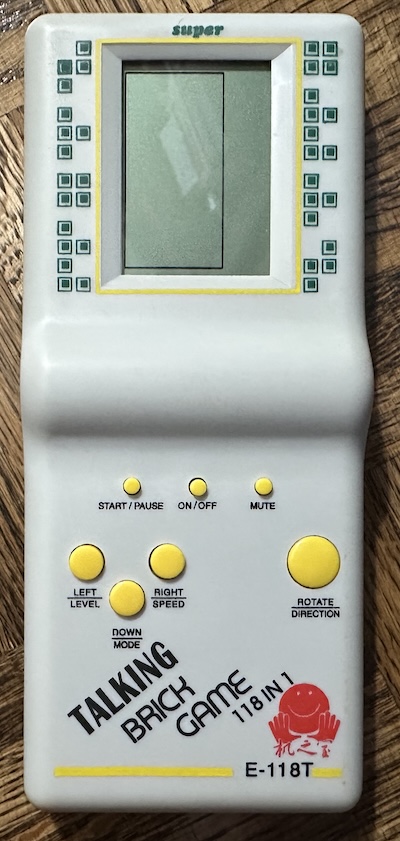
At least the fundraiser sprung for the fancy “talking” model. This is a pretty typical model, though I don’t see any year on it, even though I do have the packaging.
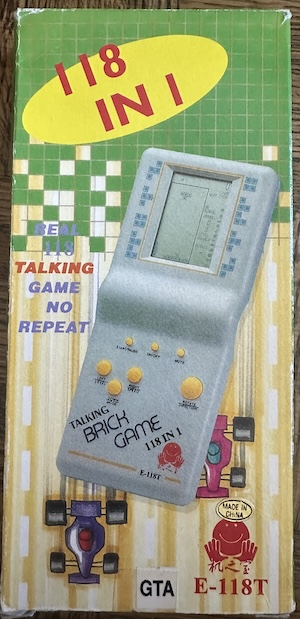
Notice that it mentions that there are no repeats, and that it’s talking. Therefore I don’t think this is the original “brick game”. However, this one does seem to predate the one we can see on Wikipedia, which promises 576-in-1, and features an “up” button.

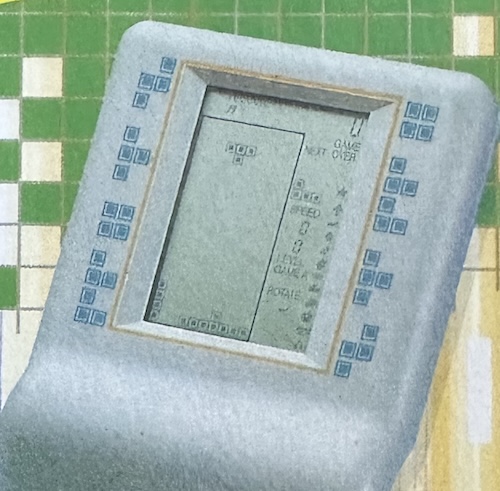
Another oddity about the box. Take a look at the screen. Notice that it has square blocks with a square inside, and a number of icons. Now compare it to the real thing.
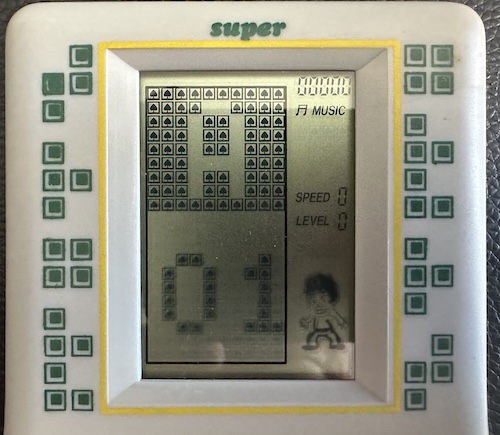
Now notice on the real thing. The block have spades inside each of them, and the sidebar segments are different too, with an odd child. I don’t really think anything of it, but it is odd.
So, what is the Talking Brick Game 118-in-1? Well, the packaging promises all sorts of games:
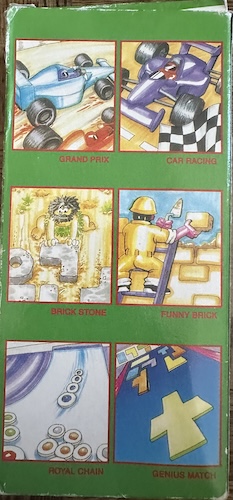
Does it talk for real? Oh, you bet. I can’t understand what it’s saying, though.
And it does boot up to a select screen. All of these have a particularly annoying select screen– you don’t scroll through the games using the directional keys as directions. Instead, look at the secondary labels. “Level” increments the level. “Speed” increments the game speed. And “Mode” increments the game type (a letter). “Rotate/Direction” increments the game subtype (a number underneath the letter). You can only increment, but they loop. In this case, the game types go from A to E. The game subtypes vary based on the game.
But there is one game in particular whose name doesn’t appear, but is basically the primary reason for the console: Tetris. Why do I say that? Well, I mean, come on. It even plays Korobeiniki when you choose one of the Tetris-like games.
That’s not to say the other games aren’t real; there are driving games, where your giant pixelated car moves back and forth, and that’s even game “A”. In fact, that’s only game “A”.
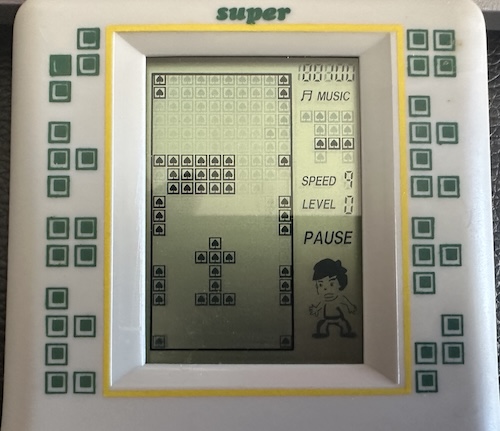
Every other game is a Tetris clone with some variant. For example, pieces may fall occasionally that are just one block. These variants are mostly annoying. Honestly, though, it’s hard to state just how big Tetris was at the time. It’s still one of the most addicting games ever made, but it was even more popular then, in an era before Candy Crush on everyone’s phones. (I guess we’re in the era after that now)
What’s inside
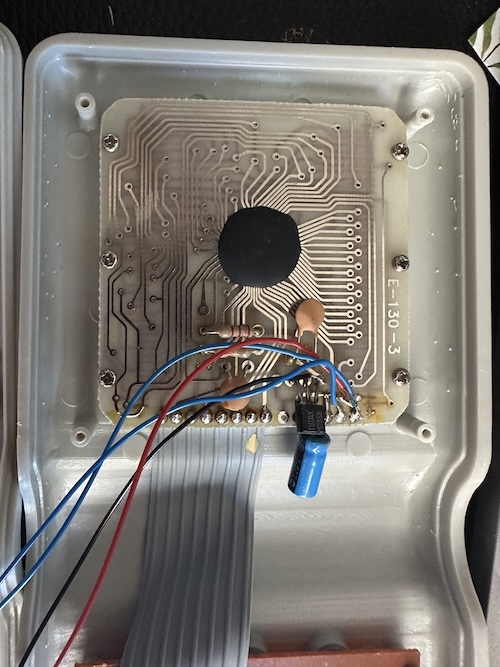
What’s inside the Talking Brick Game? Well, there’s an incredibly thin PCB behind the screen with an epoxy blob, the infamous “chip-on-board” packaging that makes it so much harder to understand what’s happening. Underneath this is the die.
And there’s a PCB behind the buttons. The buttons are individual pieces of hard plastic, with rubber contacts underneath. Extremely typical for handheld gaming consoles.
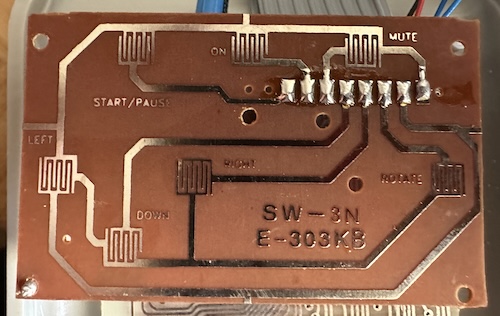
Really, the most interesting thing is the little capacitor that does some filtering of the audio, and the transistor that does… something. Unfortunately, handheld games are pretty integrated. The brick games in MAME mention using CPUs from the “Holtek HT1130” 4-bit microcontroller family, but I don’t see 118-in-1 there.
Did I say 2000’s?
Now, here’s where things get fun: the Brick Game is still around. You can buy brand new ones, usually for less than $10.
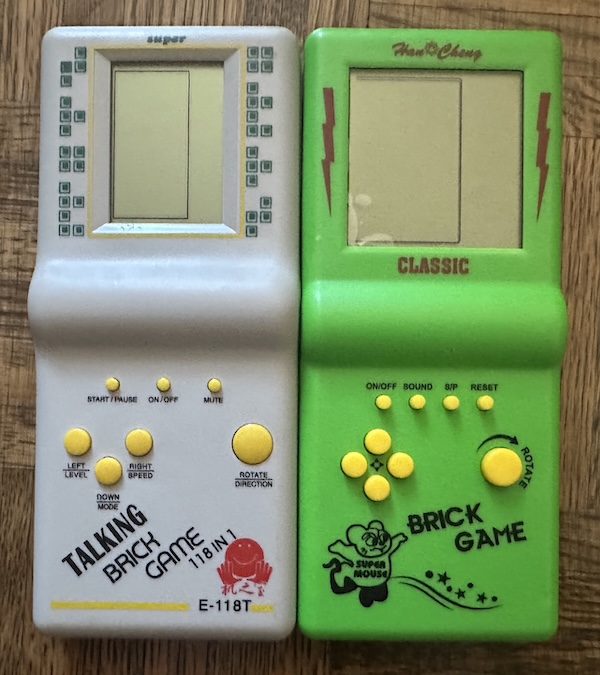
Now, the differences are subtle, but they add up to show that this actually doesn’t have much in common with the older counterpart.
- The screen is larger
- The big center hump has been moved slightly to compensate
- The whole thing is slightly thinner
- The controls are now made entirely of a single piece of rubber; they’re moved closer together to compensate
- There’s an up button and a reset button
- The rear speaker is moved from behind the controls to behind the screen
- The battery compartment has the option for a screw to hold the cover in place (not used, on mine)
All in all, while you can definitely recognize the design heritage, none of the plastic could actually be the same molds as before. Also, even though I ordered this new, there was no box or any real packaging beyond a plastic bag. (What can you expect, for such a low price?)
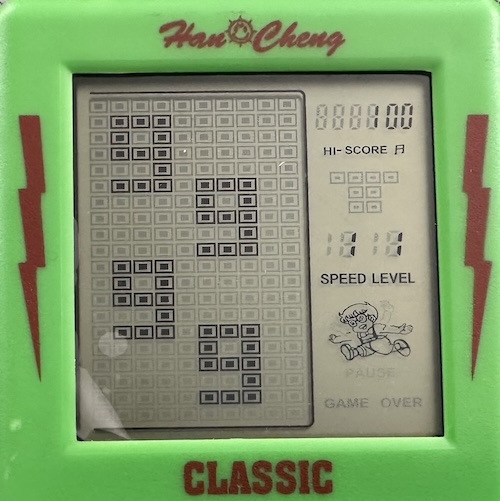
However, if they just reused the same box design, at least the pixels would actually be a box inside of a box. However, they’re not square! Even brick games aren’t free of the scourge of non-square pixels. And yeah, the screen is indeed noticeably worse in person too.
9999-in-1
You might notice the other thing: we’re no longer being modest and limiting ourselves to 118-in-1. Oh no; we’re all the way at 9999-in-1, which for those of you unfamiliar, just means “a lot of games”. And the music is different too; no more Pac-Man music here. (Korobeiniki is also gone, even though I thought that was public domain)
We’ll confirm once we crack this thing open, but hearing the audio I’m pretty sure they cut that filtering capacitor out of the circuit. This thing has decades of cost-shaving.
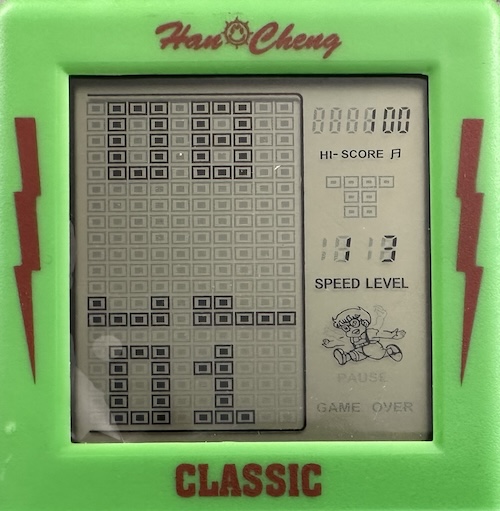
The menu’s also different. The controls are no longer labeled, and while they’re similar, they’re still different– the “ROTATE” button now rotates through the game types, and they’re numbered, not lettered. I’m not sure why; there’s only 23 game types, so they could’ve kept the letters.
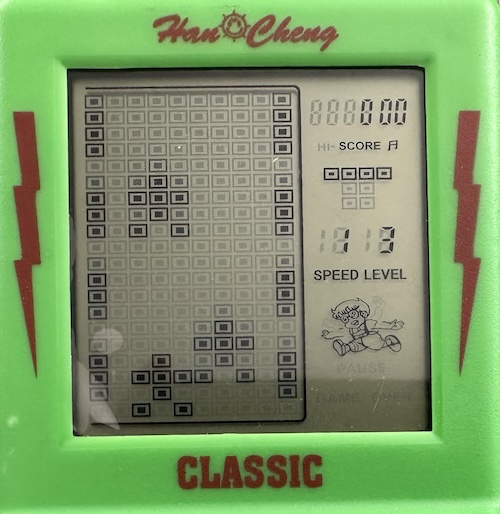
The racing game is no longer game A, and you can see it’s been completely reimplemented, with a smaller car, and you dodge other cars rather than walls. While Tetris is clearly still the main attraction here and covers the vast majority of the game types, there are some more non-Tetris games, including Breakout.
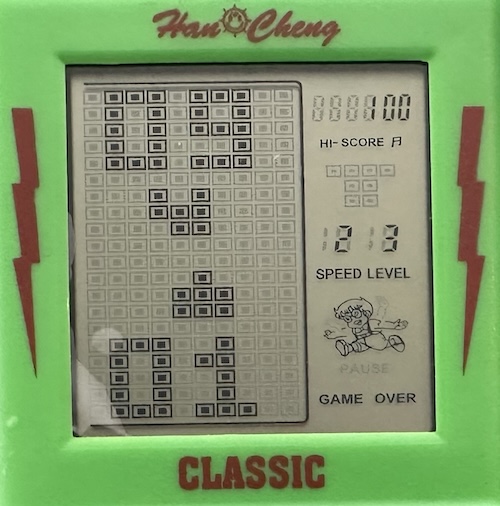
Possibly the most interesting is game 9, where you drive a tank around the screen, you do indeed need to use the “up” button to move your tank, well, up. So that explains the extra button. These differences add up to enough that I think this is a reimplementation of the Brick Game, without shared code– probably a different microcontroller core. Of course, we haven’t even opened it yet, and we already know we’ll just find a blob.
Crack it open
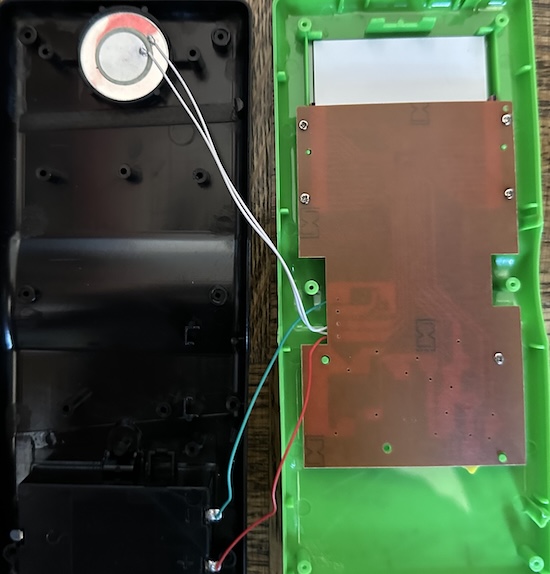
The inside surprised me. Not only is it completely different from the older model, it combines the controls and LCD connection on a single PCB. But what really blew my mind is the other side.
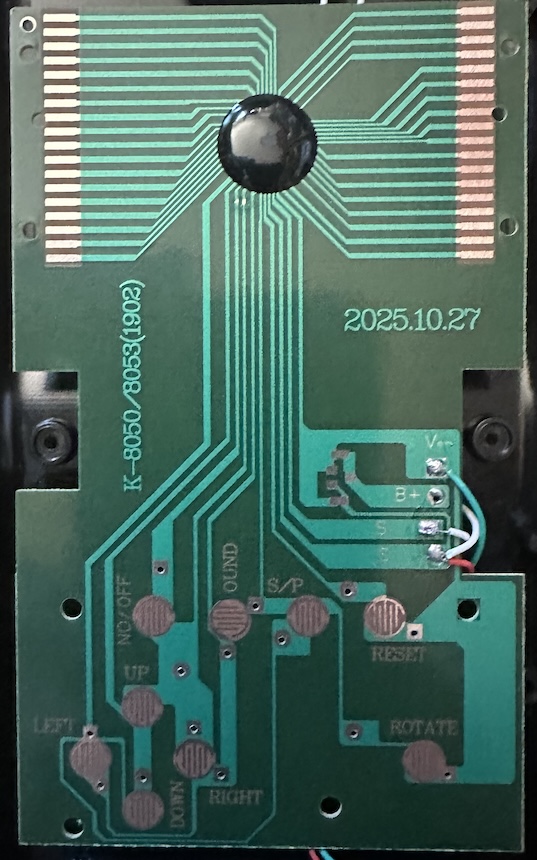
First off, let’s appreciate that perfectly round, shiny epoxy blob. So much nicer than the older matte misshapen one. They must have a tool for doing this. But the bigger surprise to me was the date: 2025.10.27. So this isn’t something they have a big vault of that they’re just selling off gradually; they’re making new ones of these these, and they’re constantly improving them, as recently as less than a year ago.
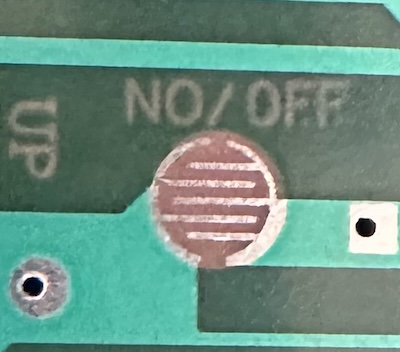
Also, like, yes, their English is nearly infinitely better than my Chinese, which consists mostly of me trying to recognize characters I know from Japanese, but I have to call out the “NO/OFF” label. I have to. Surely you understand.
Bricks
So that’s all that I can really say about the Brick Game. I had one of these when I was younger, so it really surprises me that they’re still around, but I guess it makes sense? Tetris is the near-perfect game, and there’s still a lot of children in the world who aren’t going to have easy access to anything else to play games on. In that situation, this is a lot better than nothing.