Sega Consoles Never Die: The Soggy-1000 and MD3
It should come as no surprise that I love the retro video game fandom. There is a huge outut of effort and creativity to keep game consoles alive and improve them decades after they were abandoned by their manufacturers; and this is an international effort. So today I’ve ordered a few consoles from enthusiasts in China via Aliexpress. China is a major center of this due to their thriving electronics industry, so I’m excited to dig in. And of course, how could it be anything but Sega?
The MD3
This was being sold as “Golden 16 Bit Genesi 3 Mega Drive III Superior Quality Pcb with stereo output”, which is, of course, a beautiful stream of words. But… just what are the Orcos?!!!!!
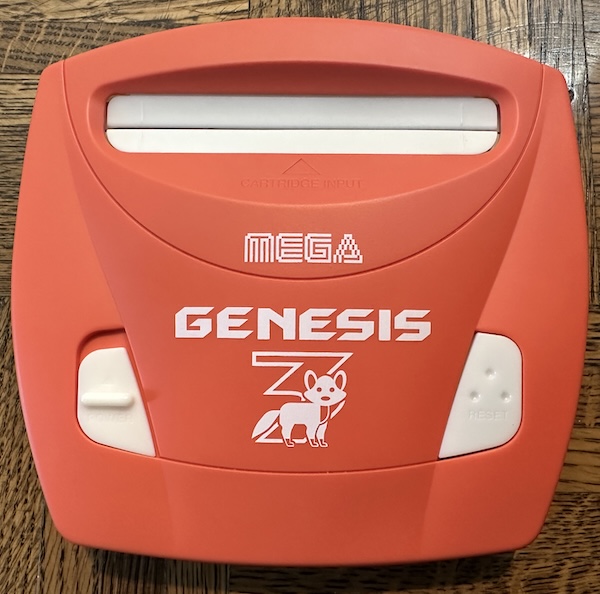
It’s a Genesis 3, of course. And I have to say this is a beautiful case; not just because of the fox art, but it feels great. I have to assume this is injection molded; I don’t actually have a legit Genesis 3 to compare, but if you told me they found the original molds in an abandoned warehouse somewhere I’d believe you. (Though unlicensed clones using Genesis 3-like shells have a long history)
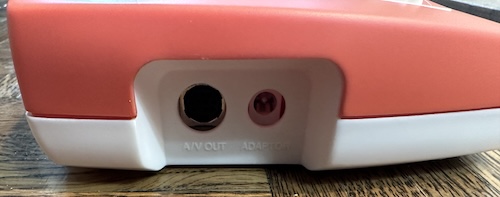
On the side is the AV out, and you can also see the nice two-tone orange and white. I need to stress something here, though: this is a Saturn-style video pinout. Do not spend a ton of time trying to wedge a Genesis 2-style AV cable into it. I don’t know anyone who would do something silly like that, do you?
UPDATE Dennis van den Broek mentioned that this might be based off of his replacement shell design.
What’s inside
First off, I have to say, it’s almost a shame the shell of this system is so nice because the PCB is gorgeous.
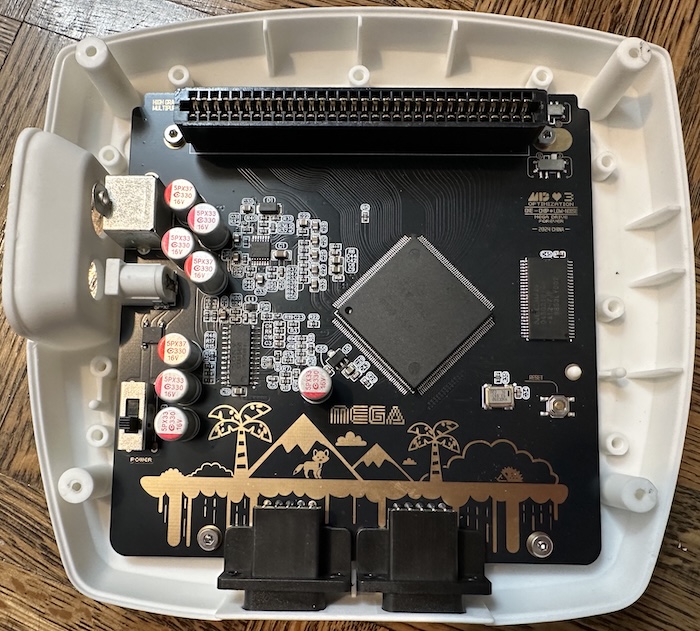
What distinguishes the Genesis 3 from later licensed Genesis consoles, like the Radica hardware or the AtGames “Firecore” system, is that it is entirely Sega hardware; I don’t believe Majesco played any role in hardware design. There are two variants of the Genesis 3; the first was basically equivalent to later models of the Genesis 2 in a smaller container. The second used the Sega 315-6123-01.
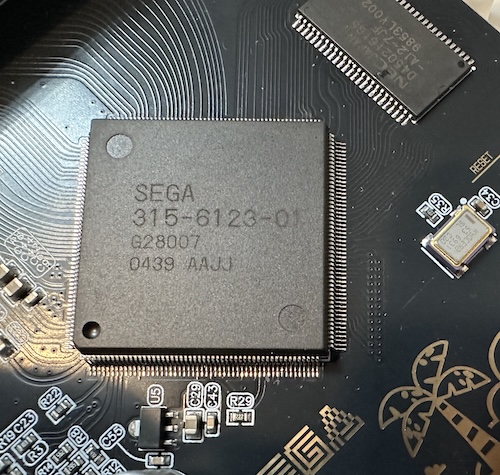
This is a “GOAC”, a Genesis on a chip. Everything, from the 68000 and Z80 CPUs, to the graphics chip, the PSG, and the FM synthesizer, are all in this square. (Not even an epoxy blob! Beautiful) It wasn’t just used in the Genesis 3 either; it also made its way to certain models of the Sega Pico. The other two ICs on the PCB are just some SRAM and a Sony CXA1645M RGB video encoder. I’m a little surprised they went with the vintage CXA1645M, actually, but it does provide composite and S-Video encoding as well.
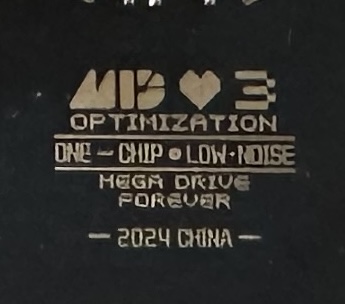
The only clue as to the creation of this board is this logo, noting that it was made in China in 2024, and provides the motivations for using a new PCB: optimization and low noise. The Genesis 3 was a discount product, after all.
Getting it to work
I spent a long time trying to figure out the power supply, and tried to question the seller, who seemed confused as well. (Language barrier, I assume) You see, there’s a sticker on the bottom:
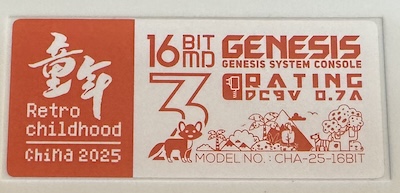
The sticker mentions 9V DC 0.7A. I think anyone who gets too far into old video game consoles or music equipment will end up with a bunch of 9V power supplies. But it doesn’t mention the polarity. The original Genesis 3 used a center-positive power supply that was compatible with the Genesis 2, but that power supply doesn’t fit in the hole. The classic trick of measuring polarity is to use a multimeter to see which side is connected to ground, but in this case, that revealed neither was.
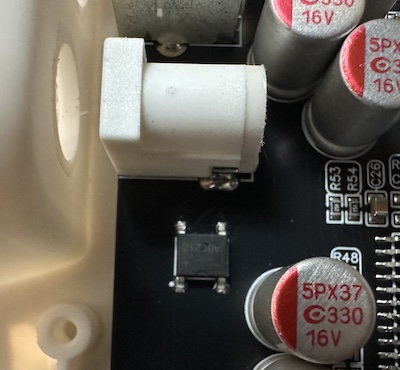
Eventually, I figured it out. This tiny chip is an ABS210, and it’s a bridge rectifier. Typically, bridge rectifiers are used to convert AC to DC, but in this case we’re told to use a rectified 9V DC supply. So all this bridge rectifier is actually doing here is ensuring that the polarity doesn’t matter; any 9V power supply should work.
Which would explain why the seller was confused.
Sega!
The use of the 315-6123 GOAC has tradeoffs. The upside is the design simplicity. The downside is that it lacks signals that Sega didn’t need for its use-case. In 1998, the Master System had been off the market in the United States for six years. The 32X had been off the market for two years. So Sega didn’t include those signals. The Sega CD was discontinued at the same time as the 32X, and as a result, there’s no provisions for the expansion port either.
As a result, the Genesis 3, even in MD3 form, can only really play Sega Genesis games. This is disappointing, but on the other hand, the Genesis still has one of the best libraries of any game console. So what if I can’t play Phantasy Star Fukkokuban?
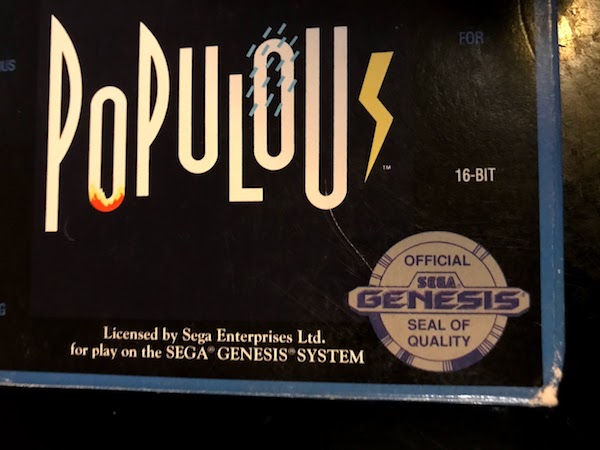
Another game I can’t play is Populous. My copy of the game is from the original run, which means that it doesn’t follow the rules of Sega’s TradeMark Security System (TMSS). Unfortunately, the Genesis 3 enforces that at the silicon level. So much for the Sega Seal of Quality.
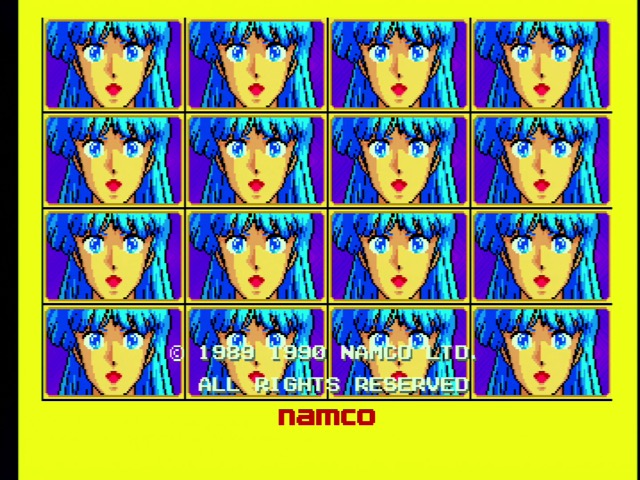
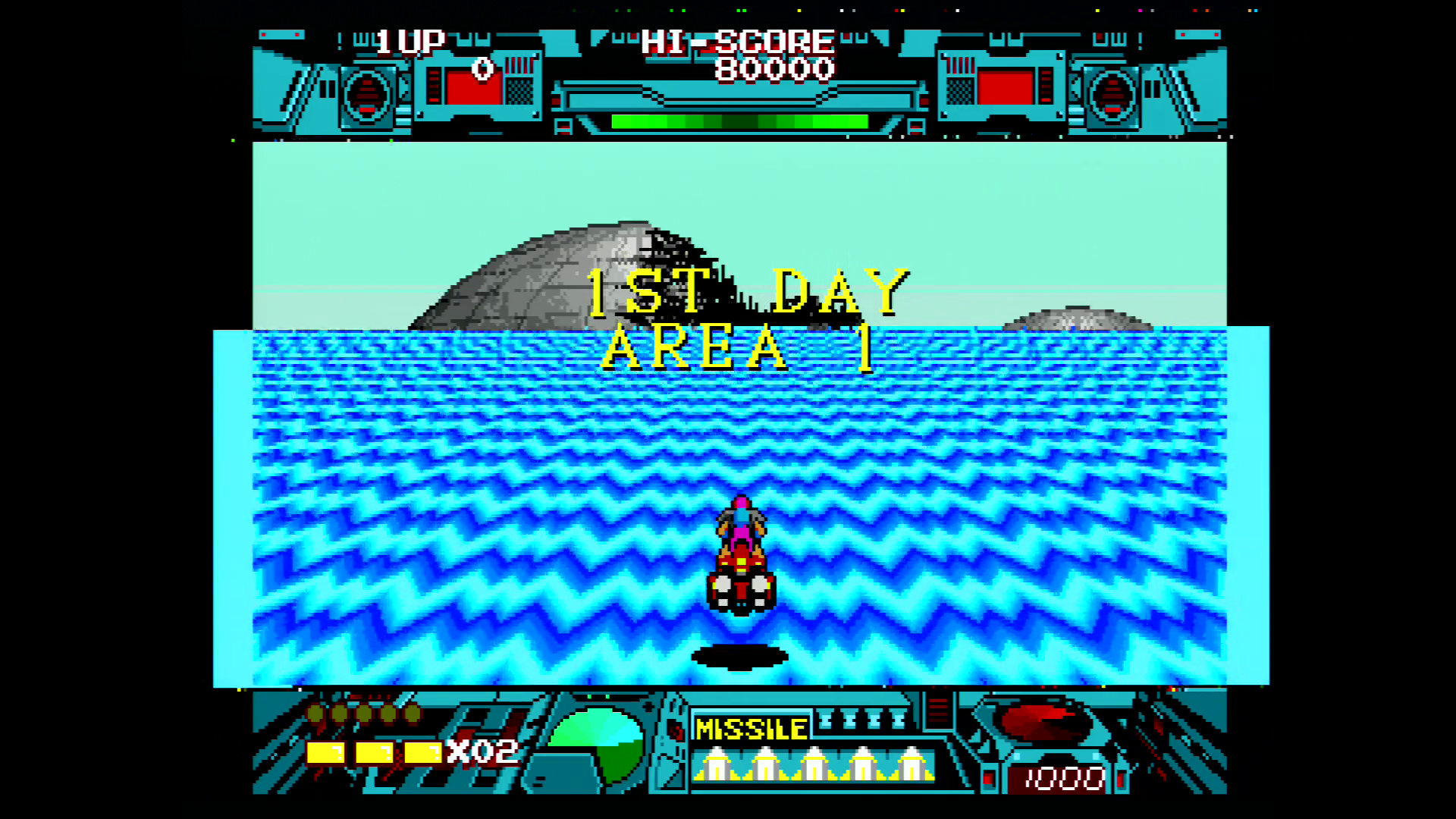
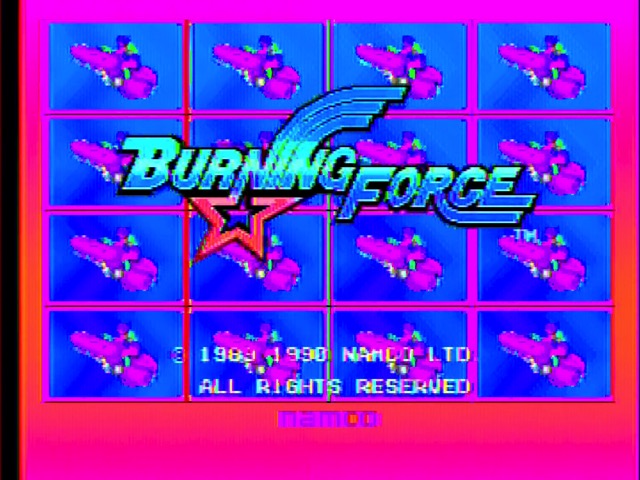
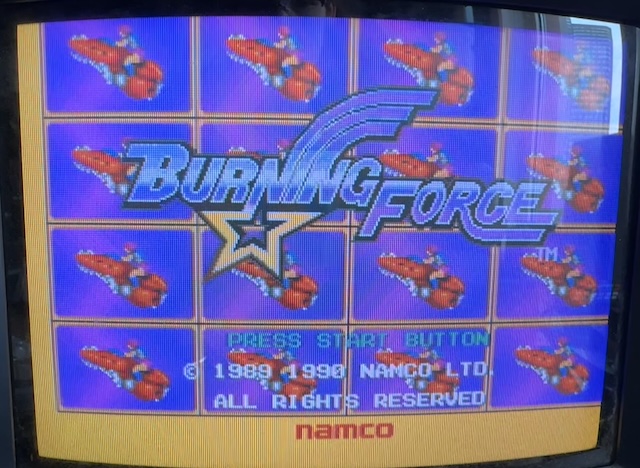
What I can play is Burning Force, the Namco classic. Here’s a screenshot taken on my Japanese Mega Drive 2, which is unmodified, with the “PC BD MD2 VA0” label, a 315-5487-10 ASIC and a Fujitsu MB3514 video encoder, through an Insurrection Industries cable. Click either image for a larger capture.
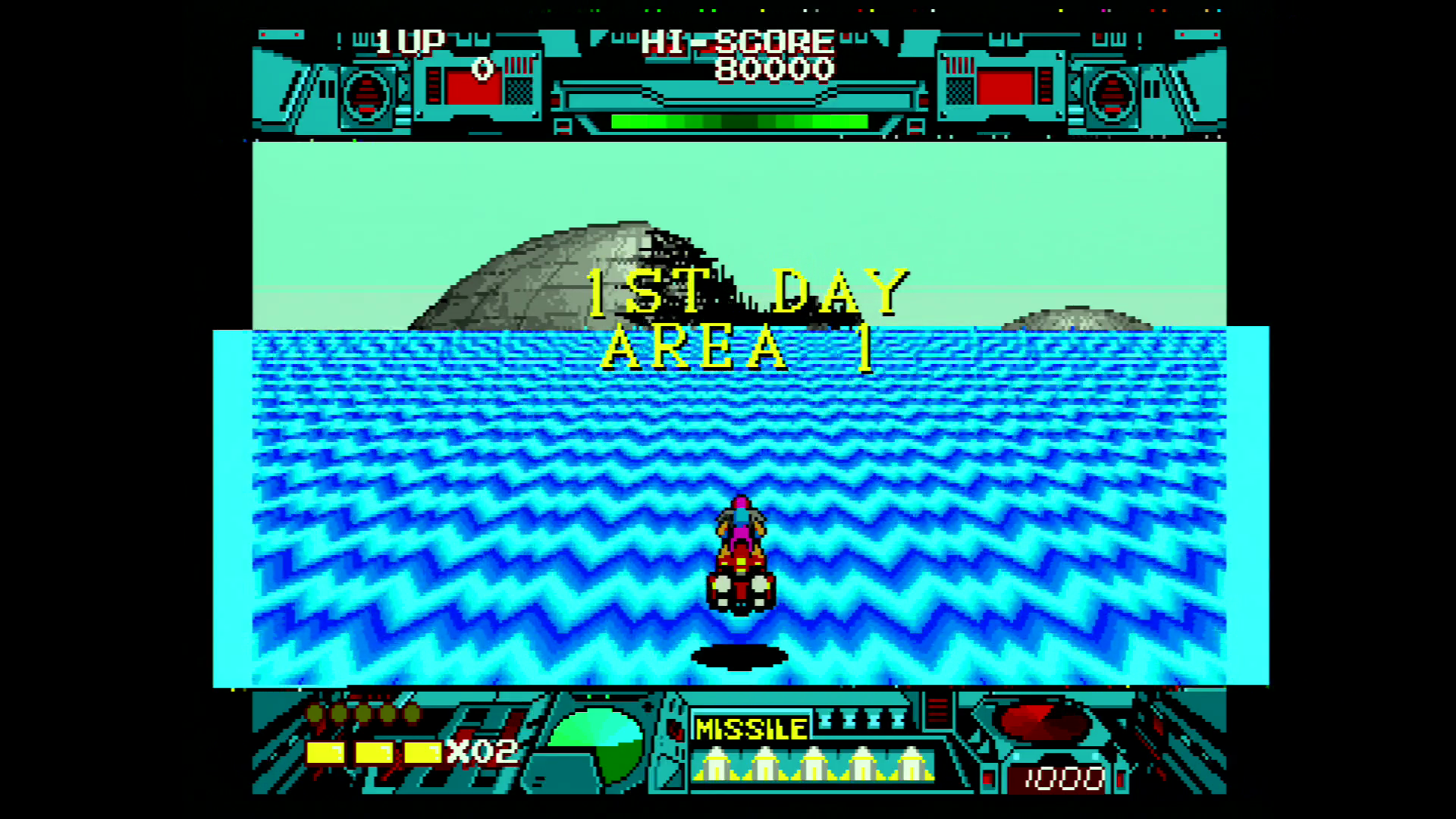
And here is the Genesis 3 “MD3”. This is using a Saturn Insurrection Industries cable, but admittedly, this cable has a lot of issues with inconsistent pictures. I think there’s a loose connection, but if so, it’s inside the molded end.
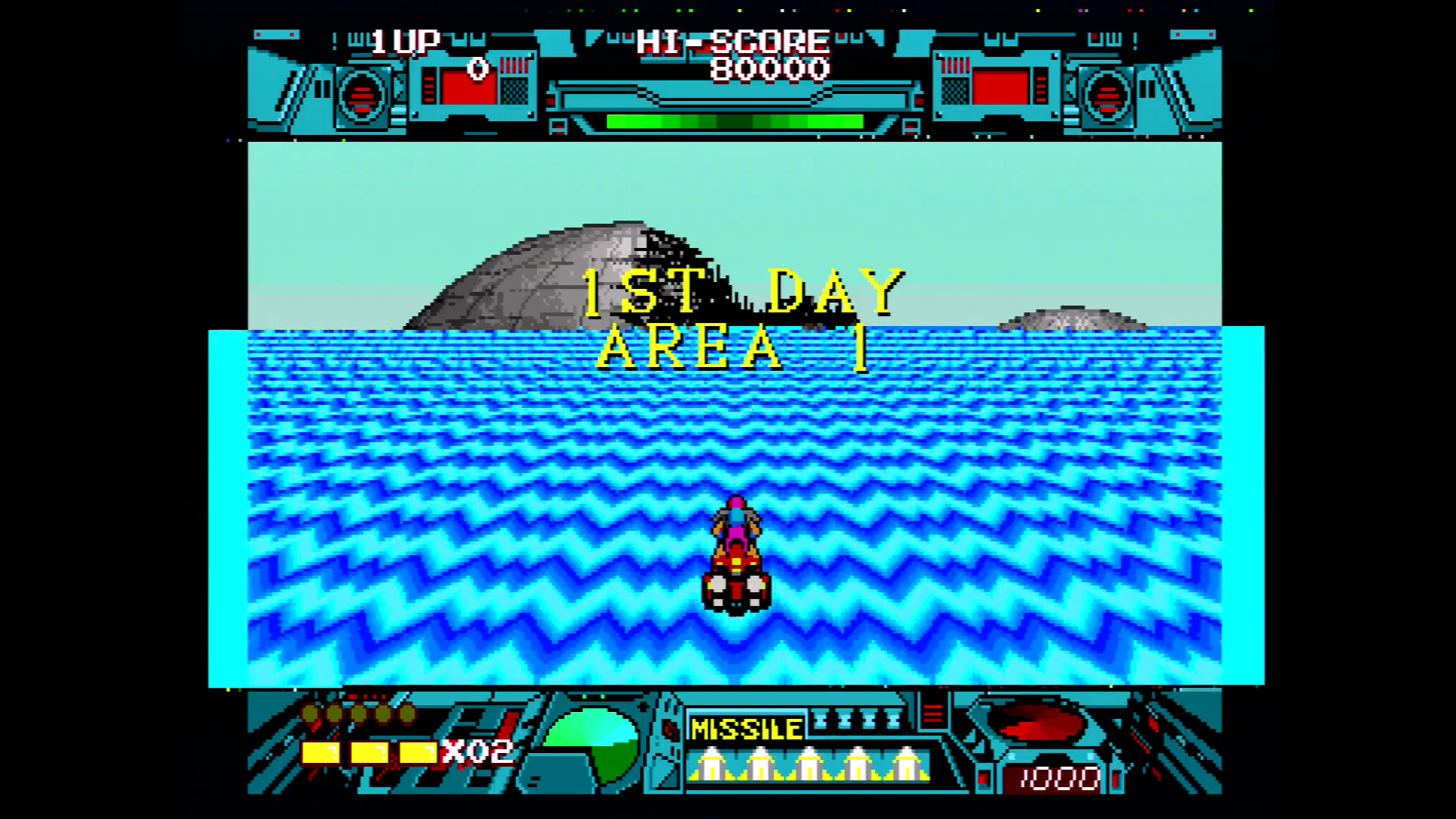
The green is definitely a little stronger in the green and weaker in the red. However, that sounds like the cable; it’s why it’s frustrating that this doesn’t use an MD2 cable. I’m sure there are good reasons for it. Other than that I don’t really see any issue; perhaps the MD3 signal is just a tad softer, but it’s within the range of capture artifacts.
To confirm whether it was because of the cable, I bought a cheap replacement Saturn cable. (Unfortunately, the Insurrection cable appears to be out of production) This one had some sync issues so I can’t recommend the cable, but it did get rid of the greenish tint.
Of course, the MD3 isn’t meant to be compared to a Mega Drive 2; it’s designed to be compared to the Genesis 3’s default motherboard. According to RetroRGB, the Genesis 3 is already nothing to complain about in terms of video output, but audio is lacking. Before that, though…
Has this ever happened to you?
There you are, innocently putting in Virtua Racing for the Genesis. After all, you think. Virtua Racing doesn’t work on the original Genesis 3 motherboard, but with this PCB, it should be possible.
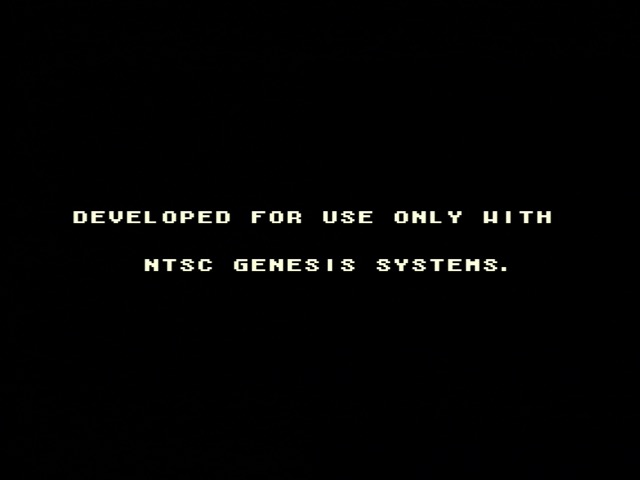
Oh! You’ve hit a classic flaw with later Sega Genesis games; the region lock. The Sega Genesis has bits that can be read by the game itself to see what region the game is in, and this game is rendering in the 60Hz Japan mode, which means that my US copy of Virtua Racing just won’t run; I’d get the same result on my Mega Drive 2.
But my Mega Drive 2 doesn’t have this:
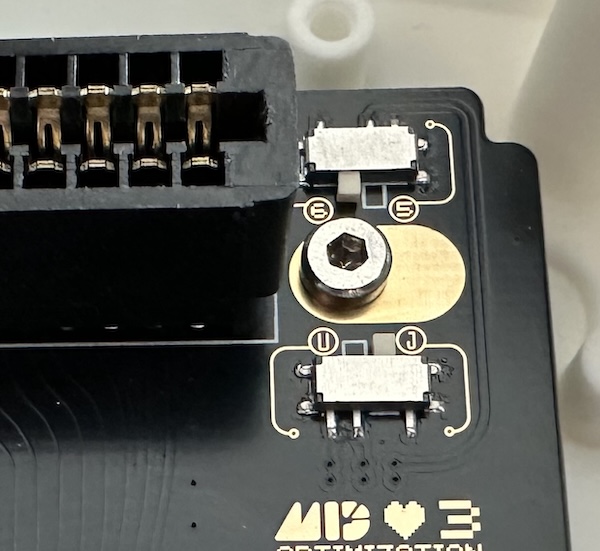
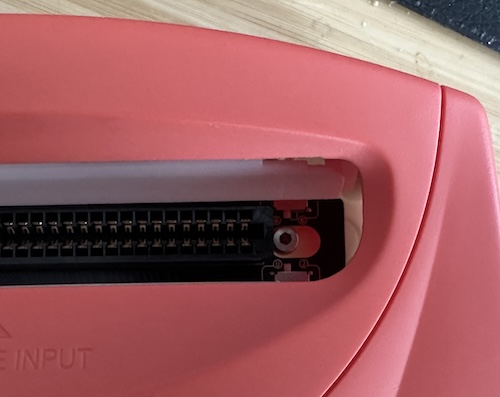
The two switches are directly configurable; they’re positioned next to the cartridge port, so even with the shell on, you can just reach them with a little plastic spudger or other tool. U/J is the overseas/Japan switch, and 6/5 is 60Hz or 50Hz. This GOAC has it all!
And with that set properly, you can play what is objectively the best version of Virtua Racing. If you define objectivity the best by having the most dithering, and being a really interesting technical achievement; how I’d love to see what the SVP could’ve done if used in other titles.
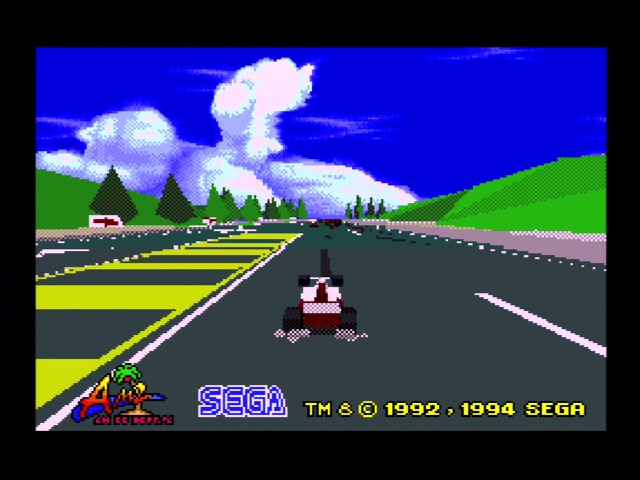
In case you’re wondering, yes, the 50Hz mode also works. I don’t usually have much reason to use 50Hz mode on Genesis, but hey, some people like their Sonics a bit slow and squished. There are systems where PAL had advantages (hello, Commodore 64), but I don’t think this is one of them.
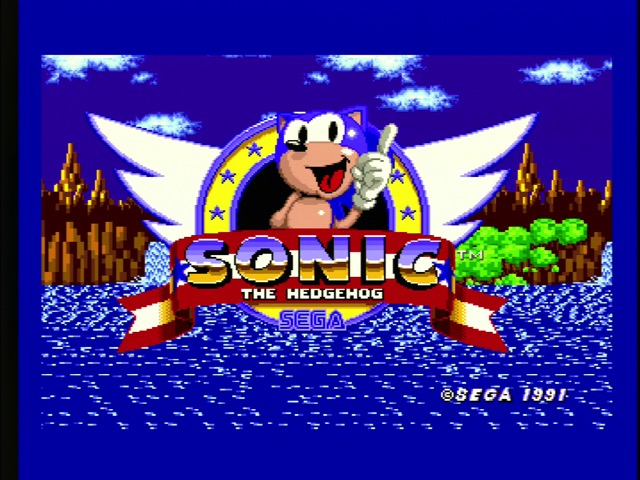
Note that while the system claims to have S-Video and composite support, when I tried either of them with a cable I had lying around, it did not work very well. Not sure what the cause of that is, it actually had a drop out right at the screen I was using to test above, so here’s the title screen.
I pretty quickly realized the flaw: I was using the Framemeister, which my past comparison showed really does not work well with composite signals out of the Sega Genesis. (I believe 256-pixel-wide mode works better, but my usual test for that is Master System mode) My little baby Trinitron handles S-Video from this like a champ.
Audio
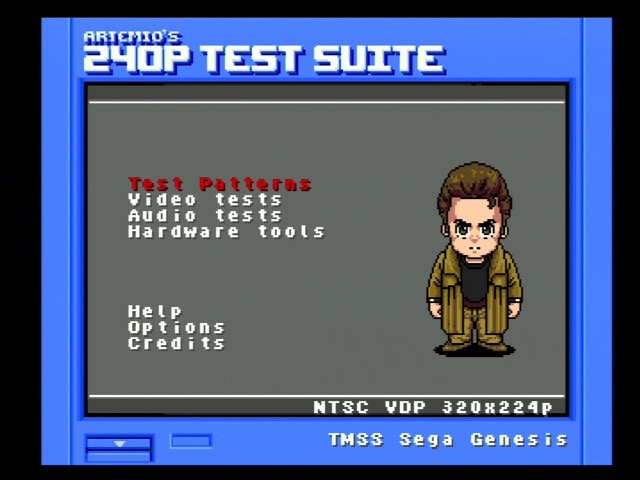
One of the more noteworthy flaws of the original Genesis 3 was that it only output mono sound. To test this, I will go with the usual tool of art, the 240p Test Suite, which has a convenient audio test mode.
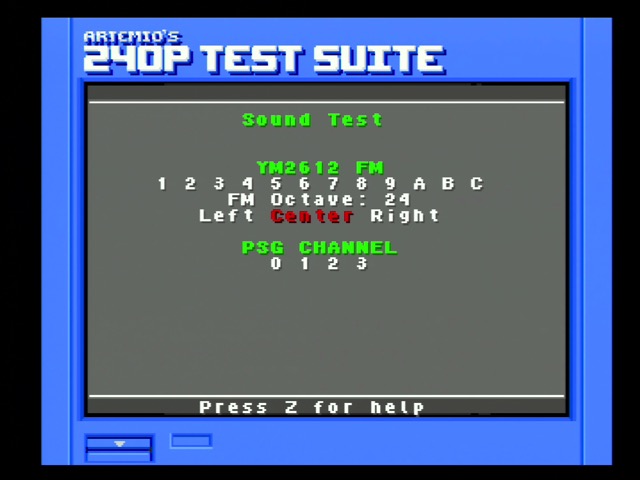
A quick try is left, center, then right. And what I got was…
Right, center, and then left. Which makes it seem like the left and right channels are swapped. And I beeped out my channels to be sure; so this is stereo, but wired wrong. Unfortunate; but if you’re using an audio cable that separates out L and R, this isn’t a huge deal. (On SCART… it’s kind of awful) So here’s Emerald Hill Zone, objectively the best piece of music on the Sega Genesis, totally not just because of my nostalgia.
For contrast, here’s how that sounds on my Mega Drive 2, notorious for having a “poor quality” sound filter. I’d say the MD3 sounds pretty good, but the Mega Drive 2 is more effective at blowing out your ears.
Apparently, this is also wired properly for cartridge audio; however, the only way I have to play cartridge audio on the Genesis is via my Powerbase FM, which doesn’t work here for unrelated reasons. If you have a Mega SD or Mega Everdrive Pro, though, I don’t see any reason why the CD audio wouldn’t work. With reversed audio. It is worth noting that like all Genesis consoles that use an integrated system on a chip, it uses a YM3438, so your music in Hellfire will be too slow but Earthworm Jim should sound fine.
Getting all Soggy
The “SG-1000 SC-3000 Retro Game Console, Compatible Cartridges & Flash Card, AV Output, 5V USB, 3D-Printed Case” is a very different animal from the MD3 above. Where the MD3 has a sleek molded case, the SG-1000 has a 3d-printed black case. Where the power supply was confusing through a bridge rectifier, the SG-1000 uses a USB-B to provide 5V to its chips. Where the MD3 used hex screws, the SG-1000 uses standard Philips head.
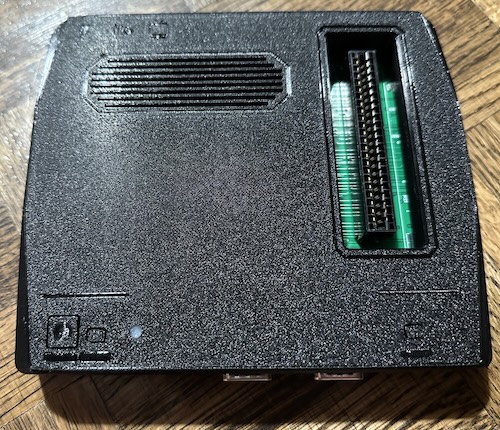
Robertson screws might’ve been more appropriate, though. Because while I purchased this one from China, the PCB here is of a decidedly Canadian design: this is the Soggy-1000, designed by Leaded Solder, whose blog is almost certainly a must-read for anyone here. And how do I know it’s the Soggy-1000?
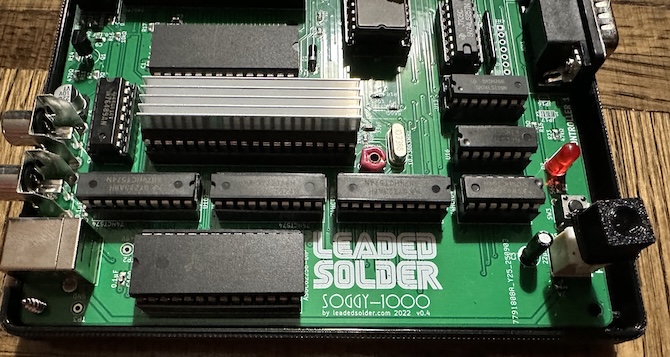
Because it says so right inside. Initially I described this as a clone Soggy-1000, but it’s not really a clone, because this is open hardware, including the 3d-printed case. This is just a pre-made Soggy-1000. They did remove the name “Soggy-1000” from the case, though.
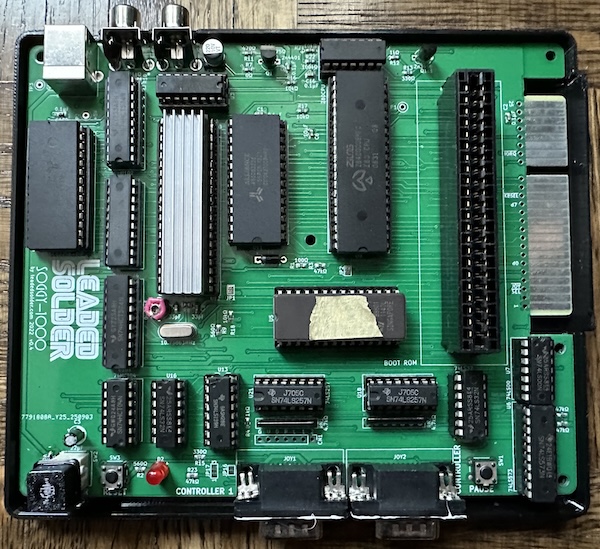
There’s no Sega ASICs here. The SG-1000 is that rare console built out of off-the-shelf parts; the TI graphics and sound chips used here (the TMS9918A, here heatsinked, and the SN76489A) were available and used by other buyers, and the logic that makes this an SG-1000 is all in discrete logic. This is quite the contrast with my SG-1000 II, which uses a Sega ASIC for everything but the CPU.
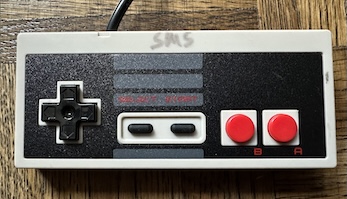
I got a controller with the system as well; this is a simple NES controller rewired with a DE-9 head at the end set up in the Master System and SG-1000 “joypad with two buttons” fashion; select and start don’t do anything (and pause is on the console, naturally). Many people don’t like the Master System’s d-pad, while I don’t hate it, I can’t deny this is a nice step up.
Testing stuff
So the Soggy-1000 is a well-documented project and I wouldn’t want to steal any of Leaded Solder’s thunder; go read his blog. Plus I don’t have the prerequisites for a full test anyway; for example, the Soggy-1000 has an expansion port for the SK-1100 keyboard, an accessory I lack.
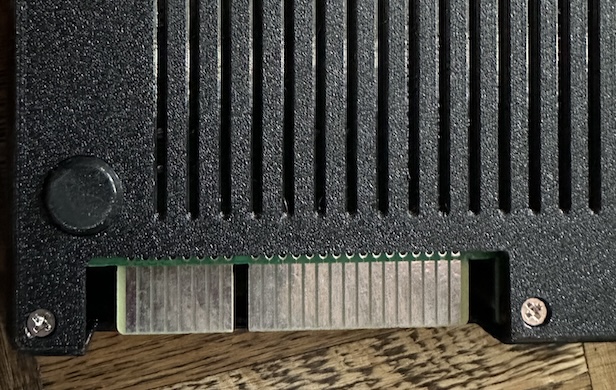
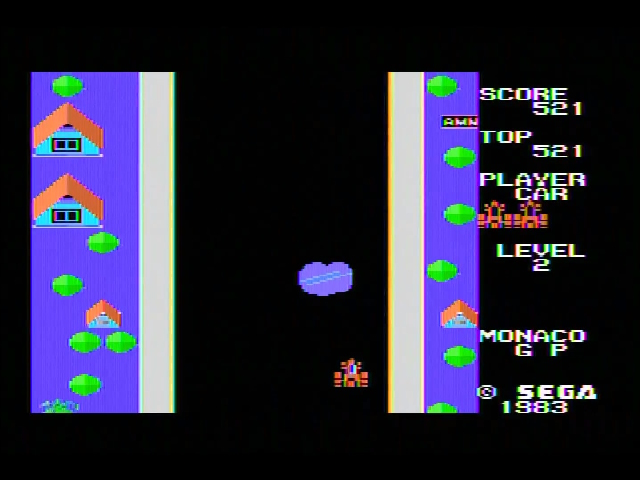
But we can do the basics. Of course, the console can play the standard tombstone-like SG-1000 cartridges, like Monaco GP. Here’s a screenshot I took back on my SG-1000 II, which has a very easy composite mod.
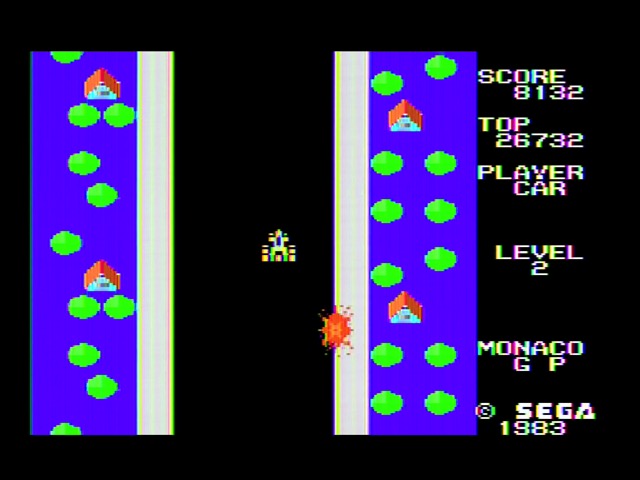
And here it is on the Soggy-1000, which needs no composite mod. Note that the difference here is mostly due to using a Sega integrated system vs. a discrete TMS9918A. I’m also not sure why my older screenshot is a bit squished vertically, it almost looks like PAL.
And it can play games on the “My Card” format as long as you have a Card Catcher. My Card Catcher’s in a rough shape, but it’s nothing a little duct tape won’t fix.
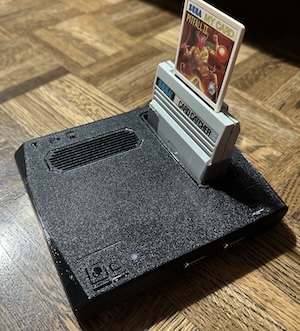
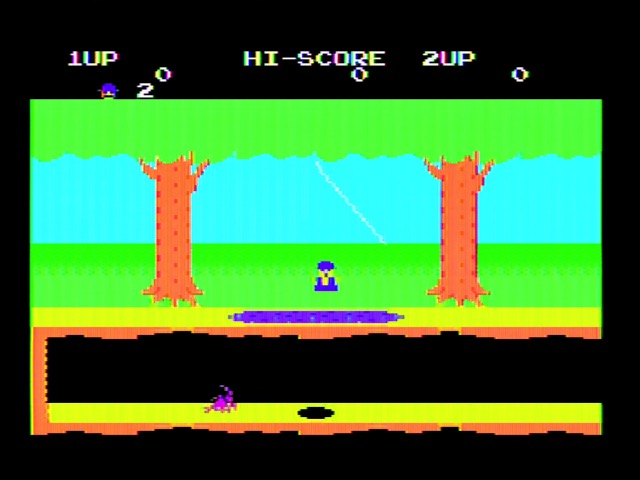
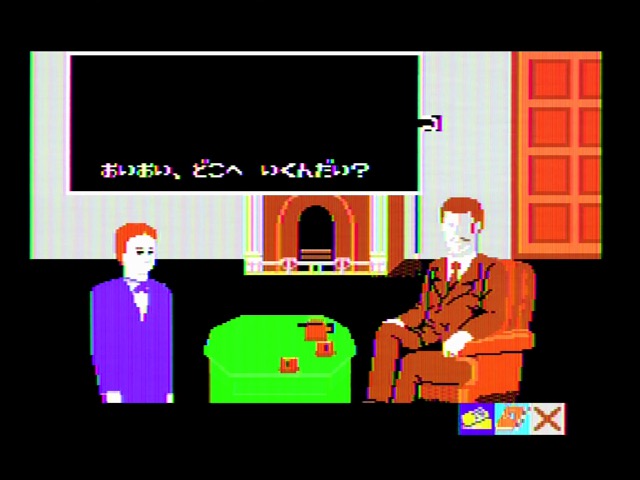
I’ll even break out a fancier title– Sherlock Holmes: Loretta no Shouzou. This is a late SG-1000 title that uses a mapper for larger memory capability. While The Castle had 8kiB of onboard RAM, I believe this is the only SG-1000 cartridge that banks ROM.
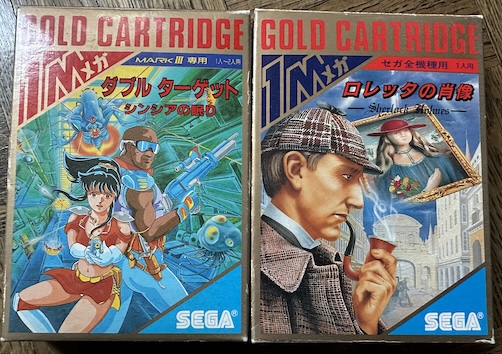
Taking a look at the box next to Double Target, a Mark III exclusive, you can see that Sega even branded it the same as a game for that newer system, known for its “Mega Cartridges”. But it runs fine here, whereas Double Target did not.
The Soggy-1000 includes the provision for a built-in game, should such a pre-programmed ROM pop into the relevant socket through means unknown to modern science. Oddly, the game here is Uranai Angel Cutie. (“Uranai”, 占い, means fortunetelling)
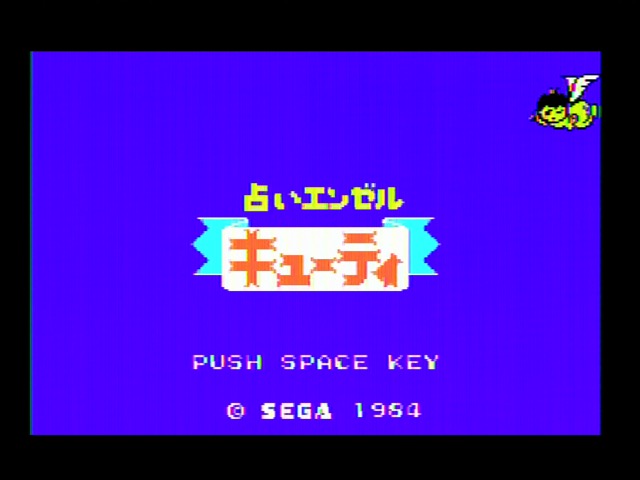
This is a fortune-telling game for the SC-3000. And I do mean the SC-3000, in that it’s not really possible to get very far without a keyboard attached; perhaps this is set up to allow quick testing of SK-1100 support?
Note that the Soggy-1000 does not have support for the coin button necessary for the SG-1000-based arcade games. I can’t imagine it’d be difficult to hack it in there, though.
Segagaga– wait no that’s something else
So that’s all I wanted to get at with this post, was to look at some of the cool stuff coming out of the fan community. Very cool to see the ways that, while we’re decades after the replacement of the Sega Genesis by now and even further from the SG-1000, the systems are still living on one way or another. At least until Hiromi is on every channel.