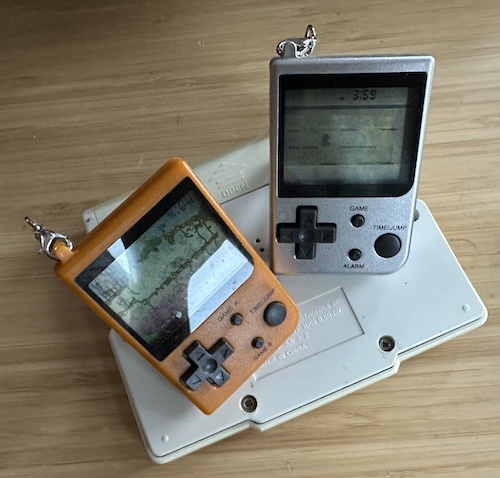
How the Segmented Game changed, through the Eyes of Golf
The 1980s were a period of slow decline for the segmented LCD or VFD game. At the start of the decade, companies like Coleco were putting out tabletop games that could compete with home console ports in quality. Even as consoles improved, portability and tricks like the Panorama Screen kept them going, and even the Soviet Union wanted in on it. But that all ended when the pixelated LCD game consoles like the Game Boy attacked, and by the 1990s, the situation and the games were a lot different. Let’s take a look at two examples, recreating one particular game.
Bandai’s Pro Golf
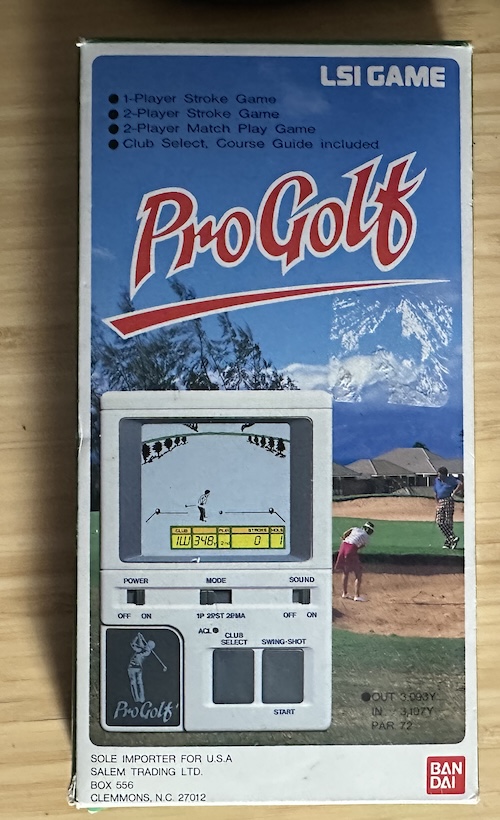
The 1984 Bandai Pro Golf is, I think, representative of what a high-end non-Nintendo LCD game looked like in the period. I was lucky enough to get it boxed, and the box promises a lot; this little LCD game should give me all of the pleasures of golf.

Inside, the game comes in a black plastic-pretending-to-be-leather case, which unfolds to reveal not only the game, but a course guide and all of the rules.
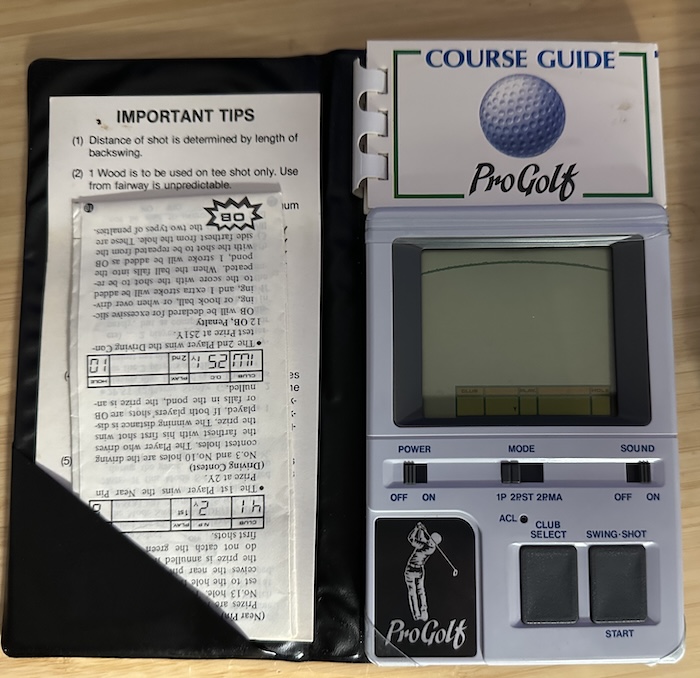
This tells us something about the target audience; they were imitating the gear of a corporate office worker, who might have leather bound agendas or similar objects to denote their status in the 1980’s. LCD games like this were not just a child’s affair; someone who played golf in his spare time might be expected to play this on his commute in. (Hopefully he’s taking a train and not driving.)
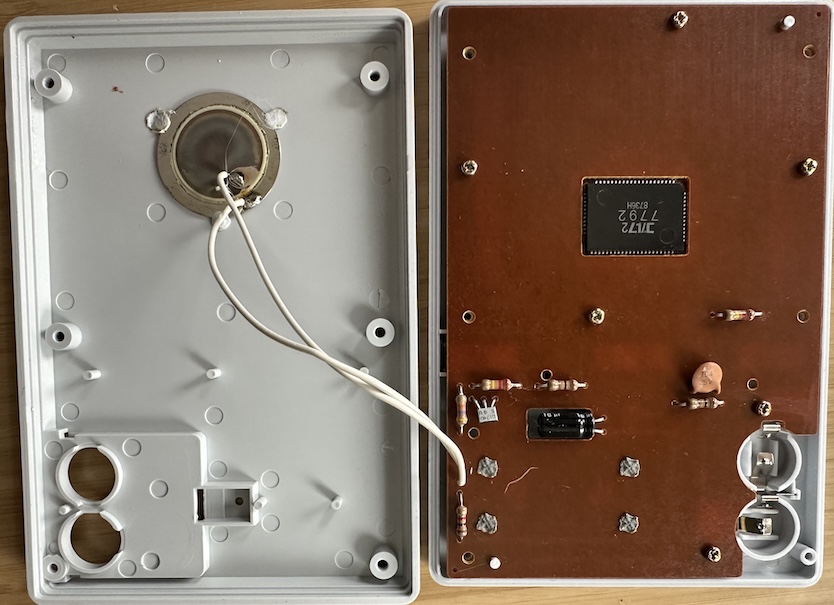
The entire point of LCD games was to be heavily integrated (one might even call them “large scale integrations”, or LSI games, like the box does), so you shouldn’t be surprised that there isn’t much inside. A brown PCB with a few passives, a single large integrated chip, and a coil that resonates with the speaker for a little more volume for far less than the power cost of a real amplifier.
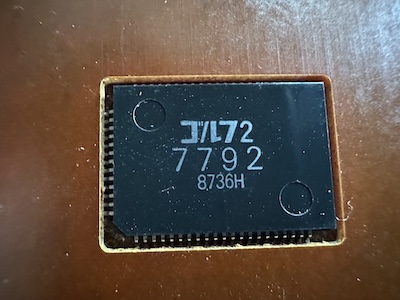
This chip is labeled ゴルフ2, which for those of you who can’t read katakana, just means “Golf 2”. (If you can’t read the Hindu-Arabic numeral 2, it’s II in Roman numerals) This isn’t Bandai’s first golf LCD game.
Gameplay
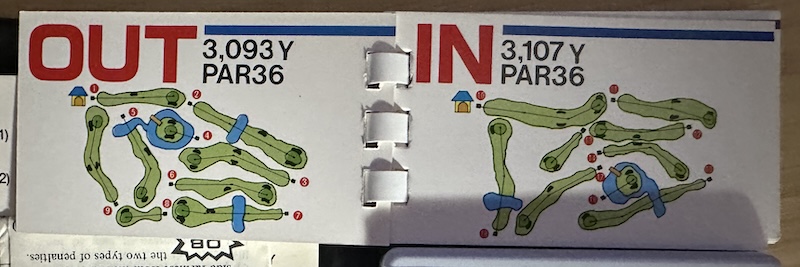
The game promised a lot. Let’s take a look at that course guide; it starts by laying out the holes like a real course would have to be, all together.
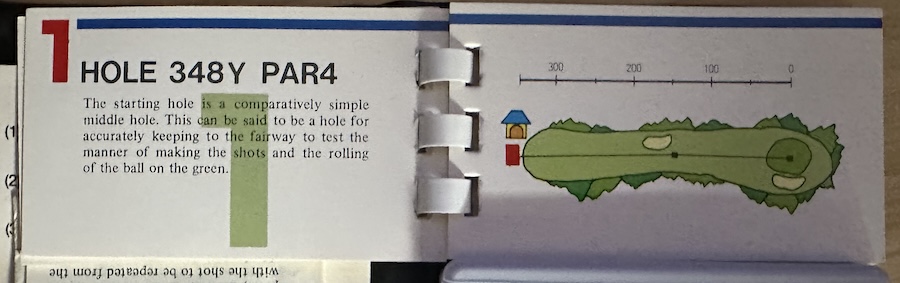
The course descriptions are also here; just like you’d get from a pre-course overview in a golf video game, but because this is an LCD game, they’re provided as an extra. That’s the sort of extra detail that shows the amount of effort that went into these games.
Let’s take a look at the back of the box again; it has some screenshots.
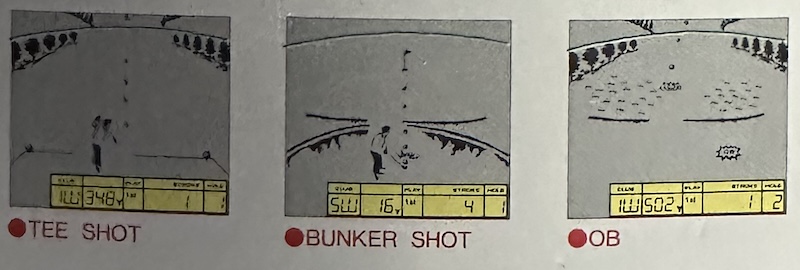
That’s right, unlike the Radica Golden Tee, this device can give you a first person golf view! But at what cost? Well, the cost that you can’t really see the specifics of the course you’re playing.
Now, let’s actually look at the actual gameplay.
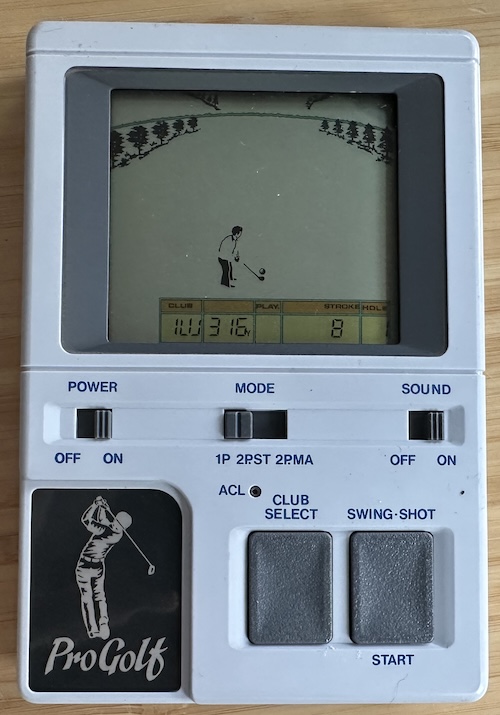
The two buttons for gameplay are the club select button, and the swing button. But wait a second; isn’t something missing? That’s right, Bandai’s Pro Golf is more or less a linear game, aiming your shot doesn’t really come into play.
You might also notice that I’m on stroke 8, but am on the first hole, a par 4. In my defense I really struggled to get ahold of the swing mechanics here; the timing feels really tight for what it is.

Segmented displays allow for pretty high detail, as you can see in this little image of your golfer at his golf bag. This is in the small space next to the club select, but if you were to recreate this image with pixels, it’d take levels of pixel density we really didn’t reach in mainstream consoles until the Nintendo DS.
Time warp!
Now let’s jump ahead five years, and break out Tiger Electronics’ Miniature Golf from 1990. I don’t have it boxed, but that makes sense; rather than coming in a reusable cardboard box, these came in blister packs that you had to destroy to open. And look at how much smaller the screen is!
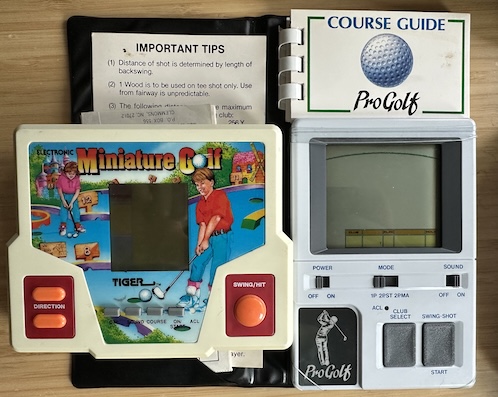
So, what changed? Well, the target audience. Tiger Electronics games were sold to children; but the businessmen Bandai targeted weren’t an option anymore anyways. And we all know why: because game consoles had become portable. Golf came out at the very beginning of the Game Boy’s launch, and it offered a better experience than Bandai’s LCD game in basically every way, even if you did lose the first-person view. And despite the name, adults were a big part of the Game Boy’s market.
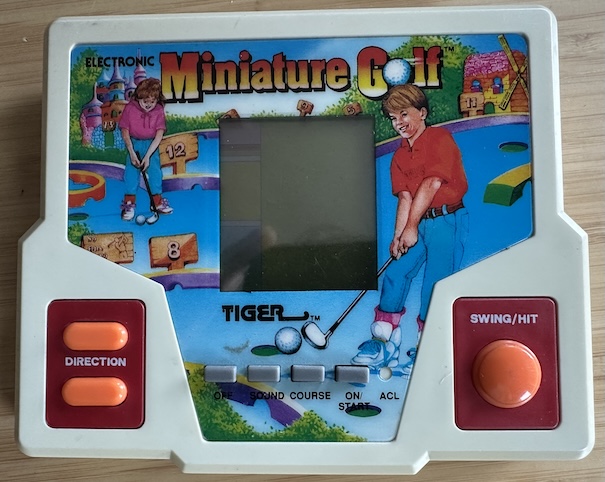
So Tiger went small and cheap. They pretty much had to.
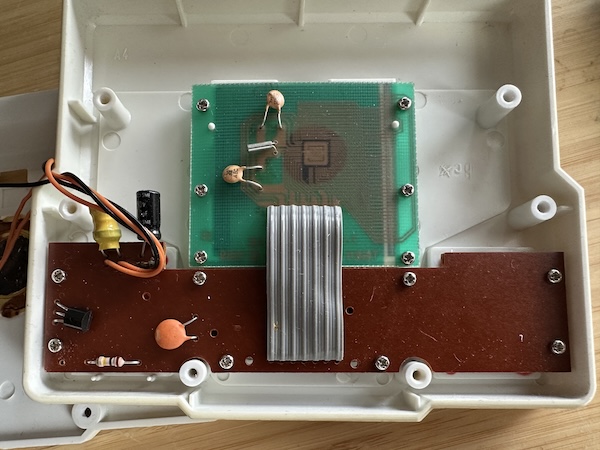
If we crack it open, the device looks a little more interesting than the Pro Golf, since the controls are on a separate PCB, and we can actually see some traces on the top one. But look closer.
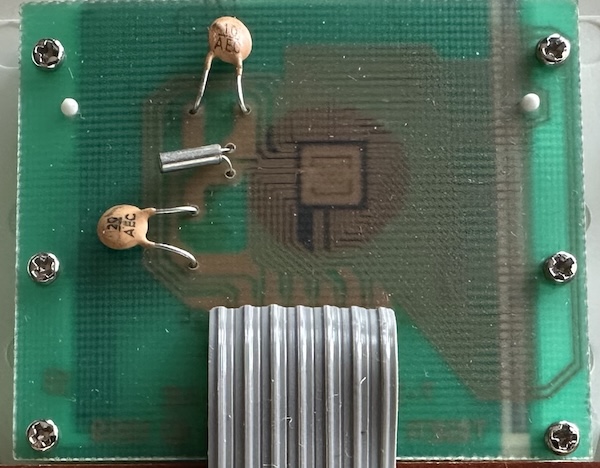
The PCB behind the LCD screen is so thin, that you can actually see through it. That’s an epoxy blob– not even a proper chip like Pro Golf– on the other side, but we can actually see the die. This is a cost-cutting move, it just happens to be one that makes the inside more interesting to look at.
You can probably tell by the buttons that this game has made a different tradeoff than Pro Golf; this game does have aiming, but no club selection. Now, club selection is pretty much irrelevant in miniature golf anyway; for those unaware, miniature golf is a variant of golf with much smaller courses that uses a putter for all hits.
By the way, the screen here is really bad, even with fresh batteries. I’m not sure if this is due to age, but the color is very grey, and it’s even harder to photograph. This is a careful angle caught by sunlight, which was the best I could do.
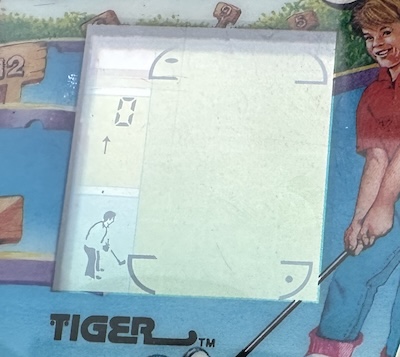
This is the first course. The black curved lines in the corners are the obstacles, the large hole in the top left is the goal, the round circle is the ball. The multi-button press process to hit the ball is just as confusing and strict in timing as Bandai’s golf.
You can see that there’s a lot fewer details than the Bandai one; there are fewer labels and fewer segments overall, despite the fact that it has to have a full set to fill the board with obstacles and the ball in any position, since it doesn’t use the first person linear course trick.
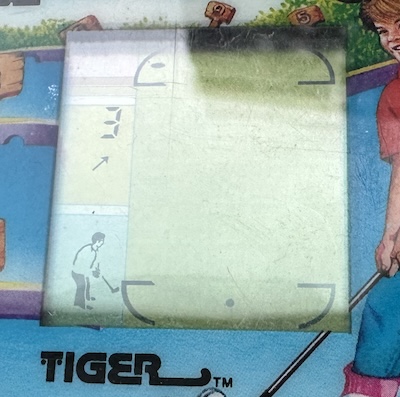
The biggest problem, though, is that there are only eight possible directions you can hit the ball at; the four cardinal directions, and those in-between. This can make it hard to get out of a tricky position, and means you’re really limited in how you can route. Nintendo’s Golf for NES already felt limited enough with 16; this is half that.
Gamers
So the answer to LCD games in both cases is, get another game. And honestly, the Tiger game is the more fun of the two, no question. (I bet you weren’t expecting that conclusion!) But it’s interesting to me how the market shifted; the Tiger game is more fun because it’s not trying to be as sophisticated as the Bandai game.
The Bandai game is reaching for the sun and falling. The Tiger game merely reaches for the moon, and even then, mostly just makes it into geosynchronous orbit. But I think it’s a good capsule of how segmented LCD games fell. No longer at the top of the market, the goal was to make them cheap to sell to children– miniature golf is one of the best Tiger made.
Probably telling, then, that some of the best segmented games of the 90’s were just those of the 80’s repackaged into smaller, cheaper shells. Even if nobody would do that for Pro Golf.