
Narcissus' Direct-to-VHS Return: MGA's Space Invaders Color FX
Remember the Game & Watch Panorama Series? The use of mirrors for a clever approach to a portable color LCD console. Of course, in 1999, you didn’t need that; this was the era of the Game Boy Color, which had a color LCD screen that you didn’t need a reflective mirror light trick to get sort-of visible color. So the panorama trick was long gone, right?
Space Invaders is back
In 1980, Space Invaders was a hit and you might’ve needed something like the Epoch TV Vader in order to play it at home at all. But in 1999, Space Invaders was already a retro game, playable on anything with a processor. Even a 4-bit processor.
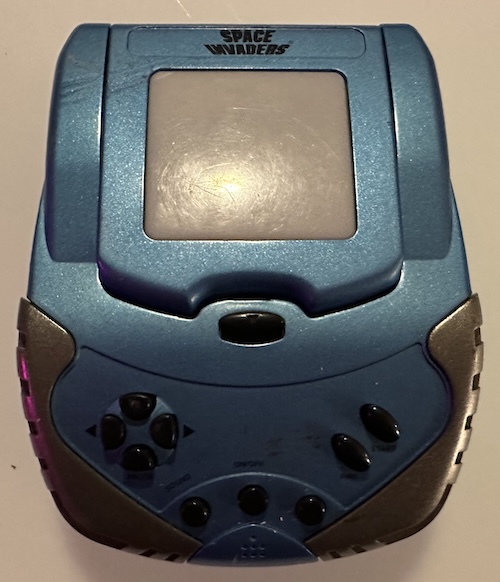
The MGA Color FX line, of which this was a part, was kind of a midrange, being a nice LCD game. MGA was doing a huge push into LCD games at the time, a niche which had been mostly occupied by Tiger Electronics, of Miniature Golf fame.
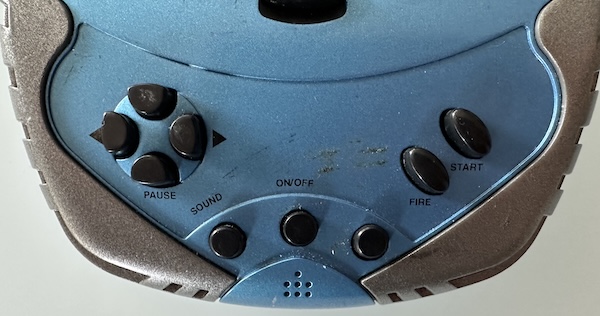
Much like Tiger’s, perhaps even moreso, MGA’s were in generic plastic shells that weren’t optimized for a particular game; notice the unlabeled buttons that just don’t do anything, and the odd positions of Start and Pause. The same game also existed in a black and white format, which shared a different shell.
Of course, the most interesting thing about the Color FX line is that screen. Press the button and the screen opens with a satisfying spring-loaded click. The Color FX mechanism is a bit simplified from the panorama; there’s only one hinge, the movable part where the light passes through the translucent plastic through the LCD and a color film layer, and on the device itself is just a mirror.
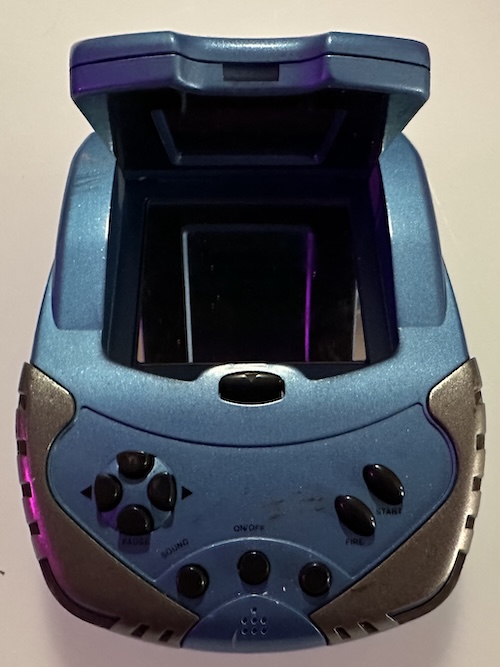
But this is the same mechanism as the panorama screen. Don’t take my word for, take MGA’s; at least, I assume they didn’t license Nintendo patents just for fun.

Patent 4,589,659 is the patent credited to Gunpei Yokoi and Ichiro Shirai that covers exactly the Panorama Series mechanism. It also references the “Table Top” mechanism with a fixed rather than moving arrangement of LCD and mirror (used in Coleco’s Donkey Kong Jr.) as prior art from the same applicant.
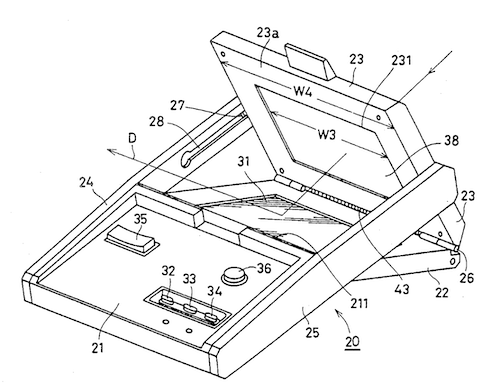
Good news for modern LCD game manufacturers: this patent has been expired since 1994. Why aren’t you making new Panorama Series games?
Inside

As you’d expect, inside everything is consolidated in a single chip-on-module chip. My guess is the chip itself is on a separate PCB than the board only in order to take full advantage of what can be reused between games.
The game
Of course, there’s been a few LCD versions of Space Invaders. MGA/Hiro’s is one of the simpler ones.
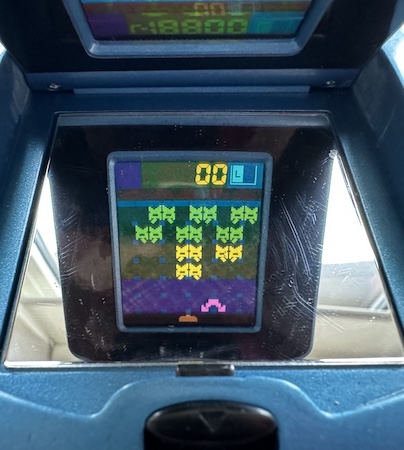
The invaders are big and chunky, and you can only see three on screen at a time. There are actually four in each row– you can see multiple rows, though, which is more than TV Vader can say. A beepy LCD rendition of the Space Invaders speed-changing theme plays if you have sound on.

The protective shells look multi-segment that you shoot the sides, but it’s more like a life bar; your ship only has five possible positions it can be in, after all. These large and limited segments definitely made the game cheaper to make than LCDs with more details, but you can tell the tradeoffs in the gameplay when almost all the invaders are off-screen in their march.
And that’s about it for this device. I was curious about this later line of color LCD games, and my curiosity is sated. There was also a later Color FX2 line that just have a front-viewing color screen, so this was really the last moment the Panorama Screen trick could’ve been useful.
Have a happy new year!