
How a Konami Cabinet Stays on Target: Target Panic!
We’ve seen a few test PCBs now; games that were only sold alongside Japanese arcade cabinets to satisfy a law requiring a minimum amount of functionality. Sega gave us Dottori-kun, a remake of Head-On; Taito gave us Mini-Vaders, another retro throwback. But what about Konami? Let’s test out our system with Target Panic!
No Expenses Spent
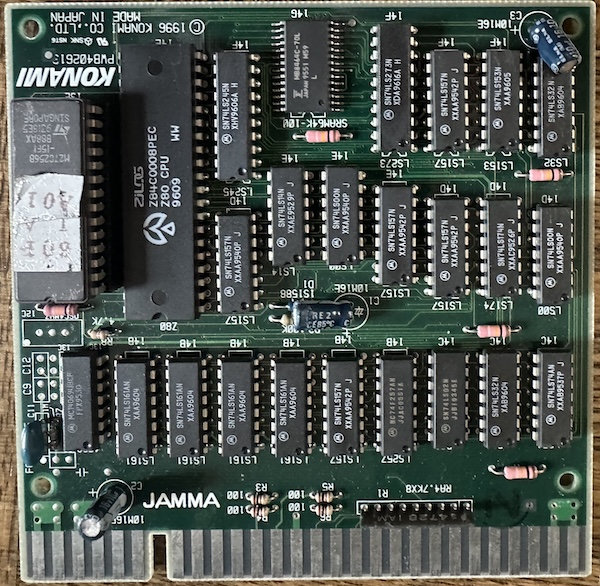
Konami’s Target Panic is a small densely-packed PCB, intended presumably to be sold alongside cabinets like the 1996 Konami “Windy”. We haven’t seen a Konami game from 1996 on the blog yet, but it’s fair to assume they did better for their retail games than a Z80 CPU. (A CMOS Z84, as it turns out) Interestingly, the position that would be taken up by a crystal oscillator is vacant on this board.
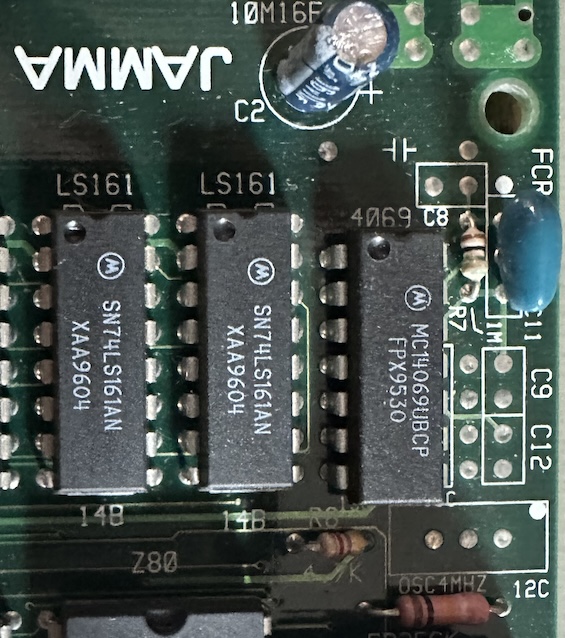
Of course, a CPU needs a system clock. Konami just went with a cheaper option– a ceramic resonator rather than a crystal oscillator. For reference, a random datasheet for a ceramic resonator gives a frequency tolerance of up to ±0.5%. A totally random crystal oscillator, on the other hand, measures its frequency stability as ±50ppm– that is, 0.005%. While these aren’t the exact parts used, two orders of magnitude less stable sounds about right.
Now, that would definitely be enough to cause some problems for a composite video signal’s colorburst. It might also just barely be audible to a human with perfect pitch, if there was a sound chip and depending on the frequency. But this is an arcade PCB intended to be run on 90’s cabinets, with RGB CRT monitors, and there’s no sound chip. Obviously Konami considered it worth the tradeoff, though both Sega and Taito used crystal oscillators.
Let’s do some comparisons between the three PCBs.
| Dottori-kun | Mini-Vaders | Target Panic | |
|---|---|---|---|
| Year of release | 1990 | 1992 | 1996 |
| Main oscillator | 4MHz crystal | 24MHz crystal | 4MHz resonator |
| Main CPU | 4MHz Z80 | 4MHz Z80 | 4MHz Z80 |
| Resolution | 128x96 | 256x224 | 192x96 |
| Colors | 8 (2 per screen) | Monochrome | 8 (4 per screen) |
| RAM | 2kiB | 8kiB | 8kiB |
It’s worth noting that I believe all three PCBs stall the CPU for at least some of the time during the active display, so the 4MHz is more of a theoretical maximum. Similarly, the four colors the Target Panic can draw are actually limited, as black and white are hardcoded. Despite spanning half a decade and three separate companies, the hardware specs barely changed. This was how you made a bare minimum game.
Both Dottori-kun and Mini-Vaders are based off of one of their respective company’s popular 1970’s arcade machines. Konami only really started to get into their stride in the 1980’s, though, so what did they turn to here? Well, they didn’t just dig into the past of their games; they dug into the past of arcades and amusements. (Sorry, Astro Invader diehards)
The game
The first thing I want to say is that despite any concerns you might have from the ceramic resonator, I had absolutely no issue syncing this device with my capture setup. So points on that, Konami; thank you for thinking of people playing your game decades later on hardware it most certainly was never intended to run on. Or for having it coincidentally work. I’ll take either.
The test
Before we start, let’s look at this self-test. This was a hard screenshot to get; I had to time it pretty much perfectly, it only lasts about as long as the Framemeister takes to sync.
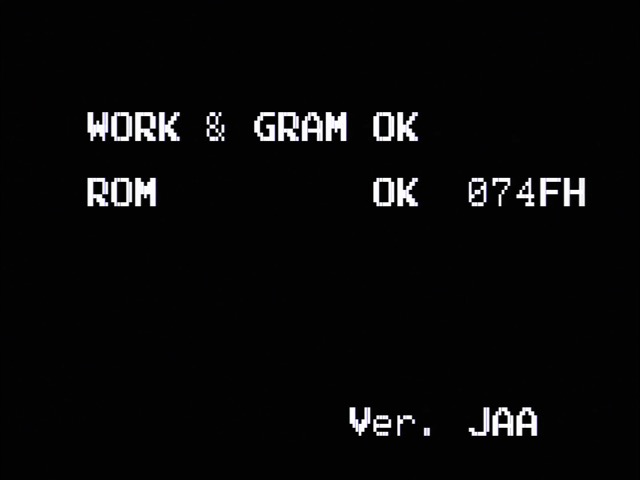
So, this might not be worth mentioning. Most arcade games start up with a self test, it’s just good practice. But let’s go back to the part where I say that it was extremely fast. Take a look at what the MAME source says:
Konami Target Panic (cabinet test PCB) It takes a while to boot up, just hold INS for a bit to fast forward.
And if you load the ROM in MAME, you will indeed be stuck on the test screen for quite some time before it finally lets you play the game. What’s interesting is, I dumped my ROM just to be sure, and it’s byte-for-byte identical. So this must be waiting on some edge case that isn’t emulated yet. Proof that even tiny boards can have complications for emulating.
The presentation
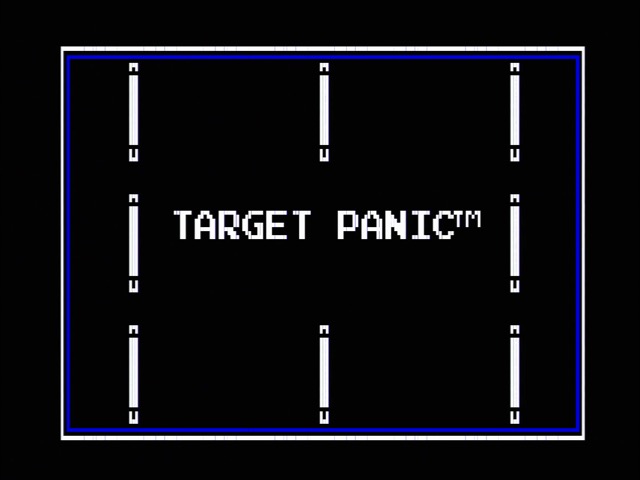
Target Panic has the most proper title screen out of any of the arcade test PCBs I’ve looked at so far. Not only does it actually show the name of the game (something both Dottori-kun and Mini-Vaders failed at), it even has copyright information, and a trademark symbol. Apparently Konami’s lawyers are very thorough.
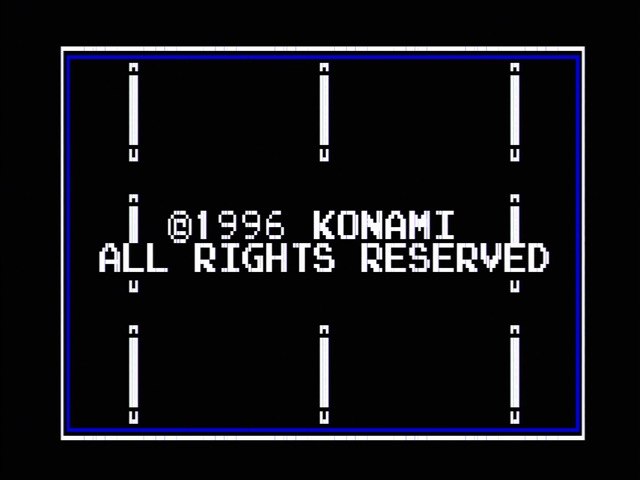
One thing I found interesting are these vertical lines that are visible in the full capture. My guess is that these are gaps in the pixels, nearly instantaneous as the 74LS157 or other logic in the chain clocks out the bits. Worth noting I couldn’t see that at all on my Sony Trintron, but it might just because it’s so small.

No really, the game
So what is Target Panic?
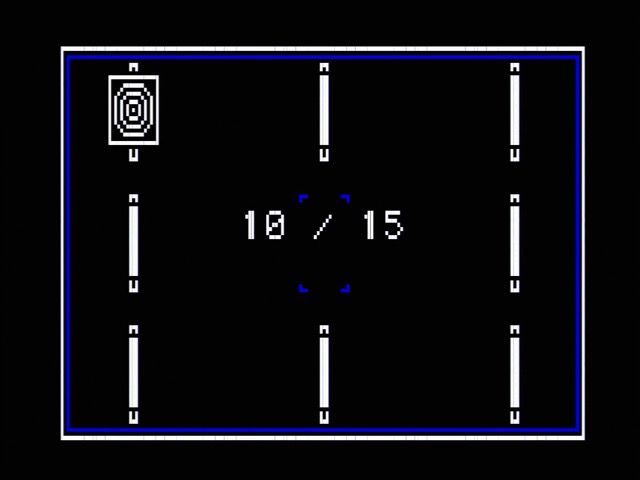
It’s a simple game where one of the eight targets that surround the screen will rotate forwards, showing itself to the player. You control the joystick, and your goal is to push to one of the targets and fire by pressing the action button. The joystick control is actually kind of interesting here; you don’t move the cursor. Instead, the cursor follows the motion of the joystick exactly; when it returns to center, the target does. Hold it left, the cursor is left. Hold down-right, the cursor is down-right. This also makes it more useful as a simple console test.
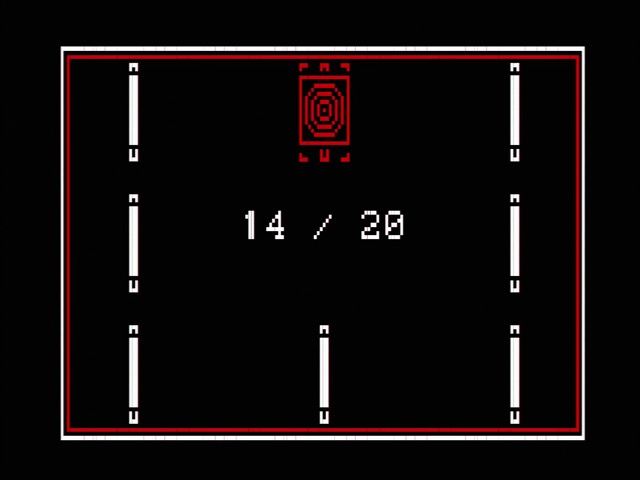
Color is part of the gameplay; it turns red when you get a hit, and then rotates back afterwards. A fun thing to notice is that when looking through the footage for this screenshot, I went back one frame and found that the game actually toggled the color bit mid-frame. You can see where it changes– I don’t believe this hardware has any way for the Z80 to know when VBlank is to avoid glitches like this.
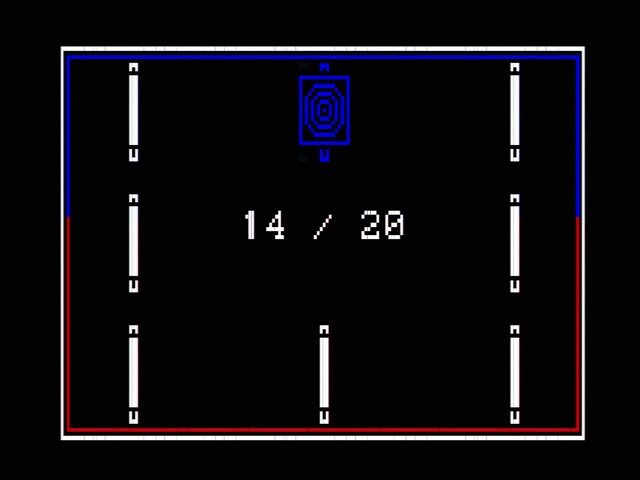
I think you can probably see why I call Target Panic a throwback to an era from before video gaming. It’s a carnival shooting gallery! The sort of rotating targets might also remind you of Hogan’s Alley. A fun little throwback for sure.
Test, again
Target Panic also contains a small service menu. Since this game is so poorly documented online, I decided to go through it. Plus, there’s a fun little bit.
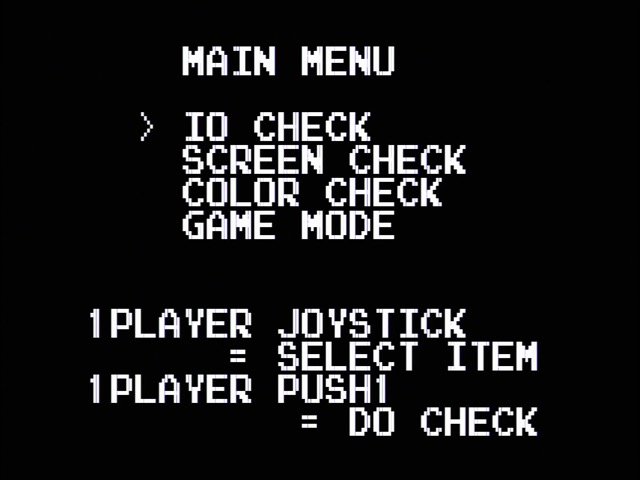
As you’d expect, GAME MODE just brings you into the game. But what about the other options?
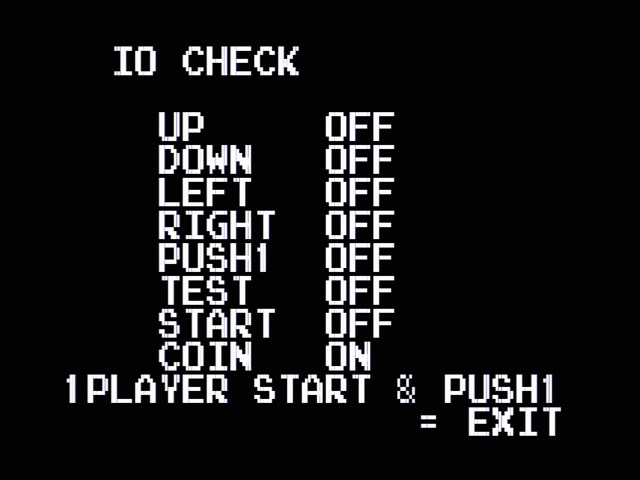
IO Check allows you to test the player 1 controls. It’s a little more thorough than just using the game to test, but it’s worth noting that there’s no player 2 options– in fact, they’re not even connected on the PCB.
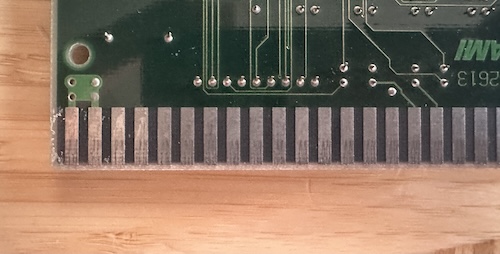
Of course, Dottori-kun and Mini-Vaders also lacked any 2P controls.
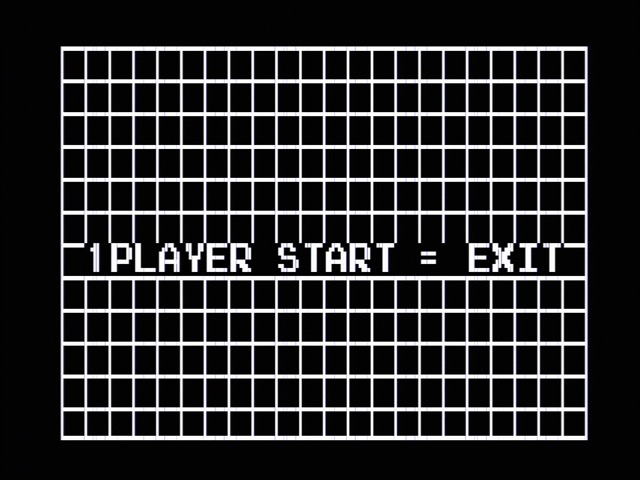
The screen test is just a very simple grid, used to measure and adjust convergence.
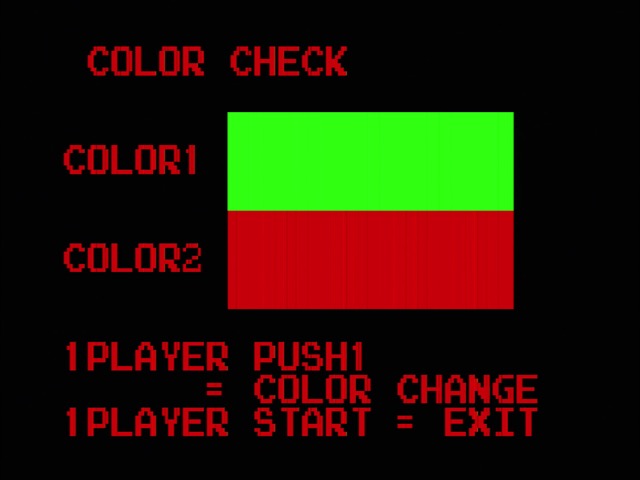
The color test allows you to see the eight colors this PCB can produce. However, it can’t display them all at once, as noted above, so they can’t show color bars. I imagine adjusting color would be very frustrating with this as your only reference.
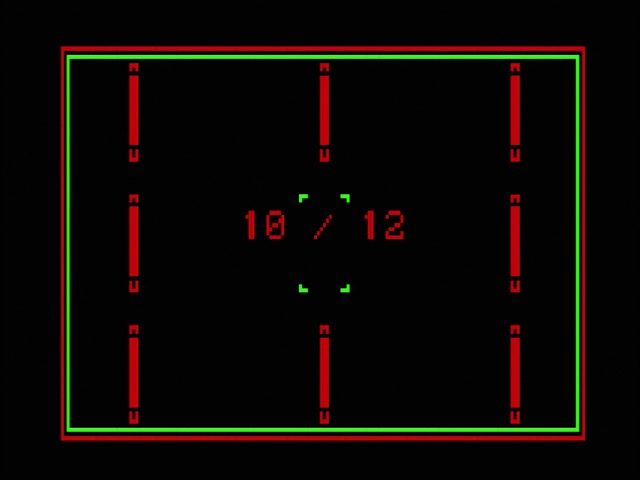
One neat thing is that if you exit color test mode, it keeps the colors you had set. For example, here I now can play Target Panic in red and green; in this case, it changes to magenta when I shoot, and persists back to red and green afterwards, so this doesn’t appear to just be a failure to reset the color bits, but something deliberate.
How much can I say?
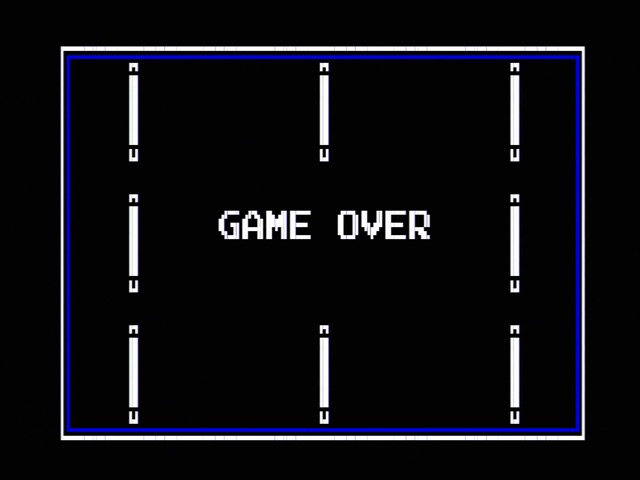
There’s not really too much to say about Target Panic. Is it even really a game, or just a piece of test software that has some game-like characteristics thrown in for fun? In any case, I think it’s neat just to see something that the general public was never intended to. I hope you enjoyed the look as well!
A series on: Throwaway Arcade Games
Games intended to be played once and discarded after confirming the basic functions of the arcade hardware they came with. Can they stand on their own?
- A Lot of Effort to be Thrown Away: Sega's Dottori-kun! — Sega's Dottori-kun, and the discrete logic that powers this simple game. Head-On is back!
- Taito's Mini-Vaders: Why Should Dottori Have All the Fun? — Taito enters the ring with Mini-Vaders. How could they do anything else except Space Invaders, after all.
- How a Konami Cabinet Stays on Target: Target Panic! — Konami could hardly be left out. Can you imagine that they used a Z80 and some discrete logic? Truly shocking.