
The TV Mahjong Game: Straight and to the Point
It’s a funny thing. The NES-on-a-chip got so cheap due to high demand, that it’s basically the default thing for a plug-and-play game console, as long as you’re okay with composite output. Nowadays, of course, the market is gradually shifting away from it to get HD, but it really had a strong heyday. So let’s take a look at one of those. One that plays mahjong! What a twist.
Color TV Game Mahjong
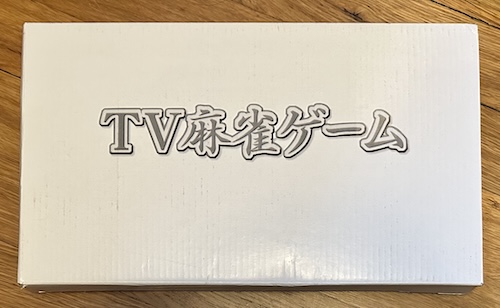
Mine came in a white box. The label, TV麻雀ゲーム just means “TV Mahjong Game”. In fact, the first thing I find interesting about this is that there is absolutely no attempt at branding anywhere. I’ve seen a bunch of these about in Japanese shopping sites, but I can recognize them only by the logo.
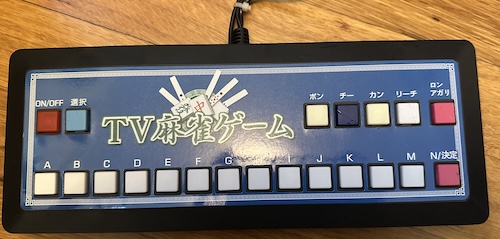
The lack of branding continues to the console itself. If you’re unfamiliar with mahjong, this is pretty typical controls for that game. Each tile in your hand gets its own button, as do the common “calls” you can make during the game. I talked about this in more detail in my first arcade mahjong post. Honestly, this controller is a lot nicer than the one I’m using there. Mostly because it puts all the buttons in a row.
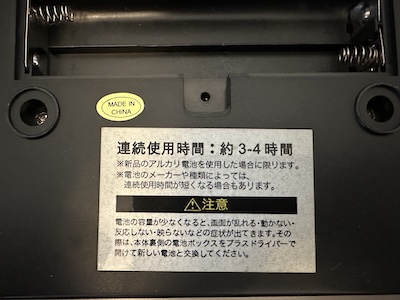
On the back there’s a warning sticker, but again, no branding. The warning sticker just lets you know the game isn’t going to go great once the batteries run down. Games of mahjong can take a pretty long time, so maybe just use the USB for power.
Oh yeah, that’s the other thing. That cable end coming out has two RCA jacks for video and mono audio, and a USB-A port for power. Which is an interesting choice, I’ve not seen that before. What I also haven’t seen before is a cable coming in pre-cut.
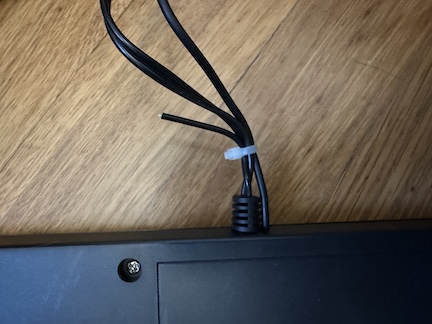
My guess is that cables for stereo audio are so omnipresent now it was cheaper to just buy one of those and cut it up.
Crack it open
In what it is clearly a luxurious move, this has not one but two PCBs. I’m kind of surprised that makes sense here, I would’ve thought making it all one large PCB would’ve been easier. Then again, the large PCB is only one-sided while the small PCB is double-sided, so maybe avoiding the extra cost makes up for the extra expense of needing the ribbon cable.
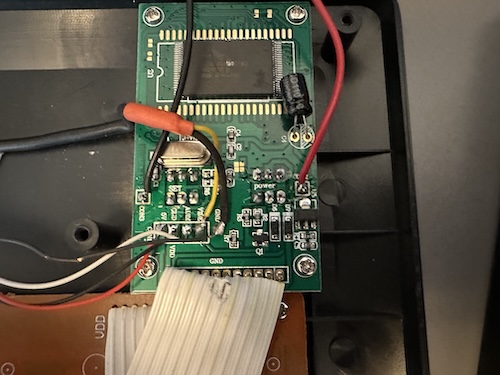
As you might expect if you’ve looked into a lot of these before, the small PCB carries a small flash memory chip, likely salvaged from somewhere, which stores the ROM. I suppose in theory this could be dumped, though I wouldn’t trust myself to do the desoldering. You can also see where the cables are soldered to. The oscillator is 21.47727MHz. If you had any doubts this was NES hardware, this should help. I talked about the details of the NES’ signal timing from this oscillator pretty recently.
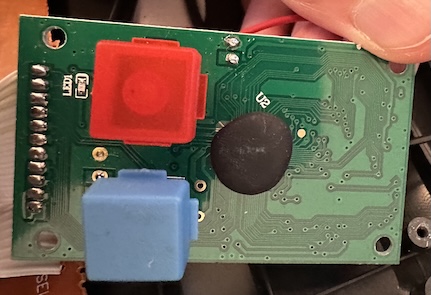
The other side features the power and select buttons, along with the epoxy blob. You probably know the drill by now; this is “chip on board” packaging, a silicon die placed directly on the PCB, with a big old blob to protect it from the elements. I’m pretty sure NES-on-a-chip are always made this way; the only NES clones I’ve seen that don’t use it are the early ones that still have separate CPU and PPU chips.
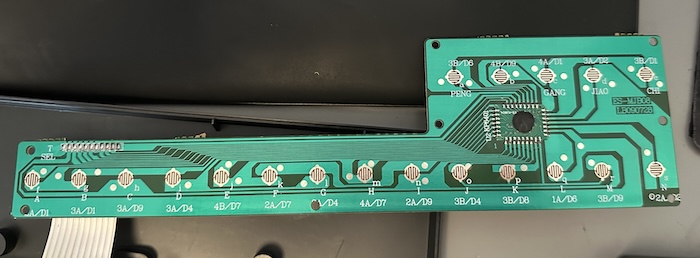
The larger single-sided PCB is, of course, the controls. While the two buttons on the small PCB are “actual” buttons, these are membrane buttons. But there’s a few interesting things going on here; I expected a completely plain one, but there is in fact a single chip. My guess is that this is mediating the controller protocol. The NES controller famously relies on a shift register; the commercial Mahjong controller from its lifetime relied on a shift register and a row select strobe.
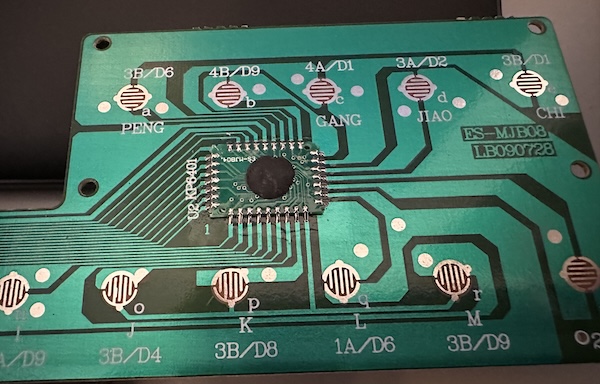
The other thing that’s interesting are the button labels. “PENG”, “GANG”, “JIAO”, and “CHI” don’t match the Japanese labels of the buttons; these appear to be Chinese words. Also, the チー (chii) button has no label at all, which is odd given that I’m pretty sure that call does exist in Chinese mahjong. This being from China isn’t surprising, of course, but it does make me wonder if they made one of these for a Chinese variant of mahjong.
Turn it on
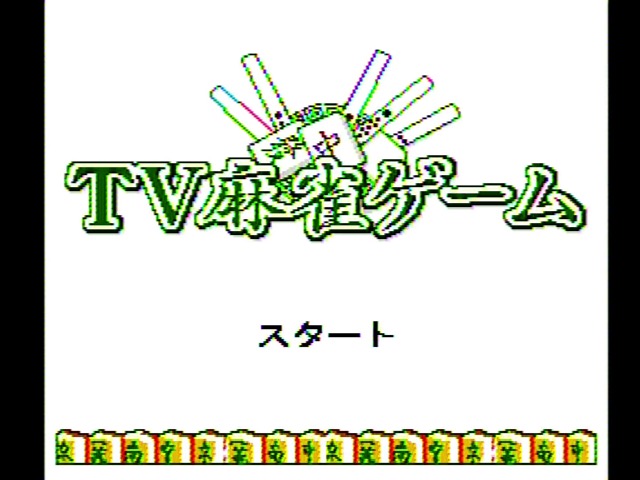
You might notice that I just assumed this was an NES on a chip. Well, it became pretty obvious as soon as I turned it on. One can get a feel for how the NES looks over composite; it’s got a certain look, between the palette limitations, the composite artifacting, and others.
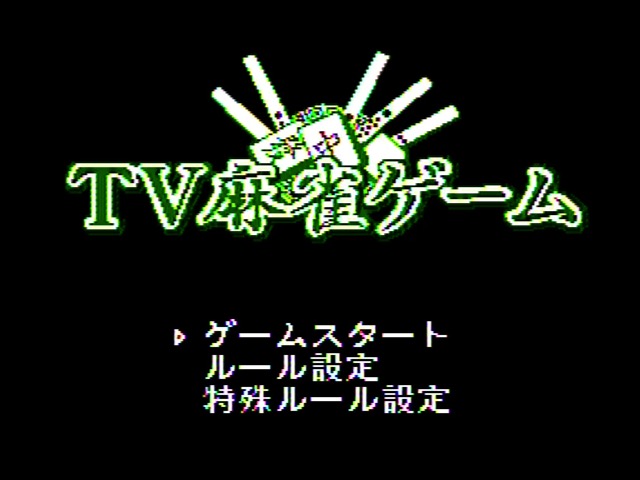
The game gives you some options, but really the main mode is just the classic two-player variant of riichi mahjong. You play enough video games, you might start to forget that mahjong is supposed to be a four-player game!
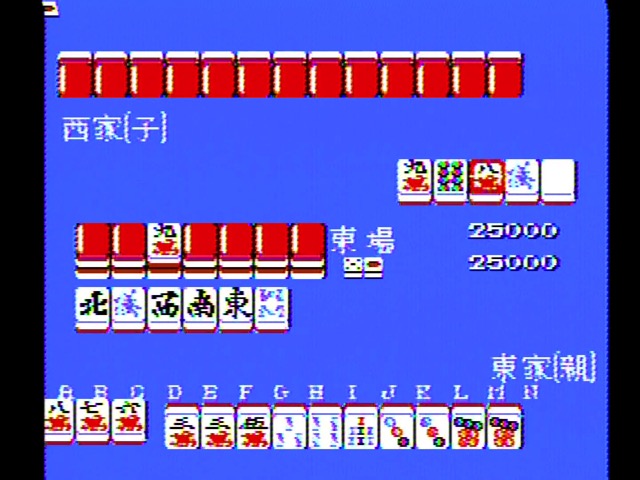
The game appears to be a highly stripped-down version of Ide Yousuke Meijin no Jissen Mahjong, a Capcom Famicom game. Of course, I sincerely doubt this is licensed; and it appears to remove the tournament mode and any other features than the basic game. Now, I don’t actually have the Famicom mahjong controller, so I can’t really play that game. However, Random Stranger did a good video.
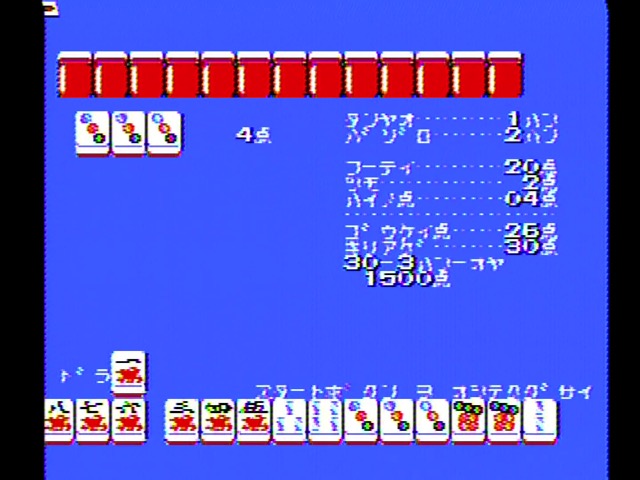
One questionable decision is that, in Capcom’s version, the background color is green. However, this game changed that to blue. This is a little odd, because in mahjong, the colors do matter. White, Red, Green, Blue, and Black. That’s five colors, and the NES can only do four using tiles, so you already need to drop one, and the usual one is blue, replacing it with green.
Why is it weird to replace green? Well, there’s one hand in riichi mahjong called “ryuuiisou”, which can only be achieved if every tile in your hand is only green. The name literally means “all green” (緑一色) in the weird Chinese-like readings used in mahjong hand names. Now, there are no tiles that are green and blue, so there’s no actual confusion here, but it does make the name inaccurate.
And if you’re hoping I’ll give an example of such a hand being played in this game, think again! Ryuuiisou is a “yakuman” hand and is one of the rarest ones. I’d have to be extremely lucky to get it even if I played this game constantly!
No nudity here
One feature from Ide Yousuke Meijin no Jissen Mahjong, if you look through the manual, is “girlfriend mode”.
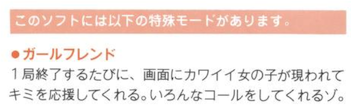
It notes that, in the aftermath of a match, with this mode enabled, a cute girlfriend will show up and cheer you on. Now, with all the code stripped out, can I still have my girlfriend? Let’s take a look at some of those rule options.
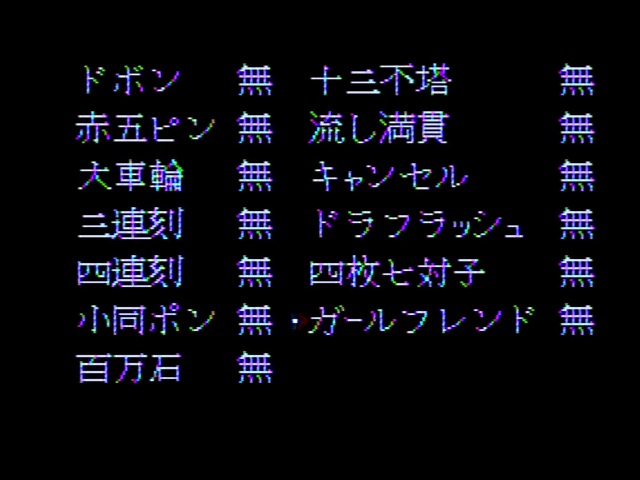
And there we see it– ガールフレンド モード. (“gaarufurendo moodo”, or just Girlfriend Mode) It made the transition from NES game to weird bootleg NOAC console, turned off by default. And just as promised, when I win a match, my girlfriend cheers me on.
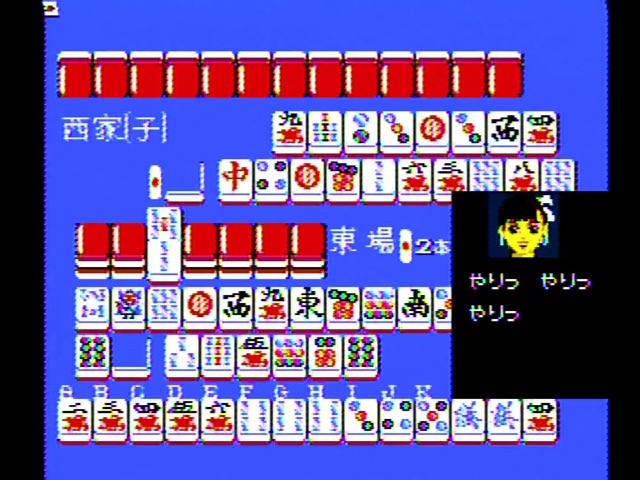
So that’s nice. This sort of feature always makes me wonder, there’s a story behind this existing, right? Or was a developer just having fun?
I don’t know how to end blog posts, so I think I’ll just cut this one off here.
Special Thanks
Special thanks to everyone who contributes to the Nicole Express Patreon! And a special call-out to the higher tier members, at the time of this post:
- Daniel Goldstein