
Playing Arcade Mahjong at Home? Or is it just a Mirage?
A lot of the things I’ve looked at on this blog have never left Japan, often for good reason. One genre that stands out in this is mahjong, a tile-based gambling game popular in Japan, associated with nudity in their arcades, and associated with old ladies everywhere else. How can we add this to our supergun? Surely that’s a question someone other than me is curious about. Reader’s note: This post will be strictly “safe for work”. The game might be too. Depends on your workplace.
Mahjong? in my Arcade?
So, first off, for a post focused on the history of strip mahjong arcade games, I’ll recommend Tsundoku Diving’s blog post on the subject. It’s one of the best I’ve seen, especially in English. Here, we’ll focus on the technical side.
As far as I know, the first mahjong game was Janputer (or “Jongputer”? “Janpyuuta”? Romanization is hard), developed by Alpha Denshi, the company that would later go on to develop the Neo Geo hardware. Mandatory reference to the Neo Geo aside, Janputer didn’t do very much interesting from a hardware standpoint. And it didn’t have any women in it at all, clothed or otherwise. But there was one thing that really stands out.
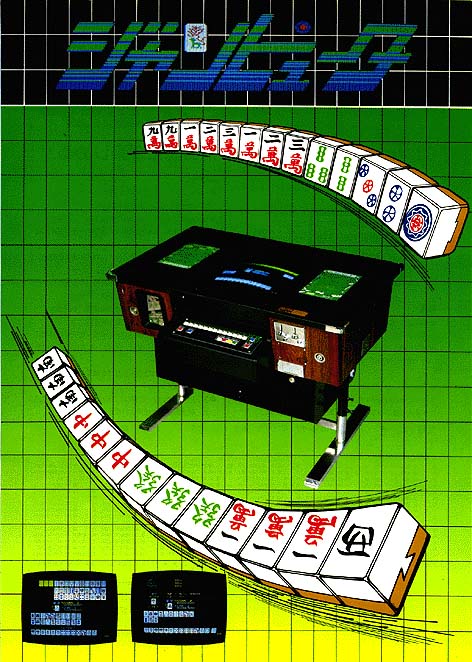
Do you see it? Take a close look at the controls. While you certainly can play mahjong games with a joystick and buttons, Janputer went for a more optimized approach, which nearly every arcade mahjong game to follow also used: dedicated buttons. I have a little dedicated USB controller meant for playing arcade mahjong games in MAME that shows the point:
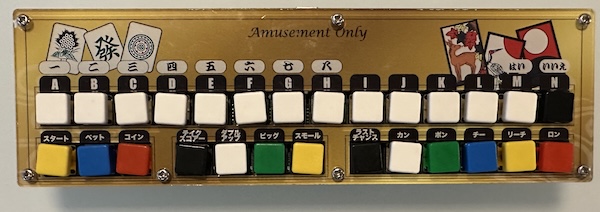
What follows will be a lot of words. If you don’t feel like reading about mahjong (and I don’t blame you, as any description of mahjong is indistinguishable from Calvinball), feel free to skip ahead: long story short, there are a lot of buttons.
I don’t want to go through all the rules of Mahjong here, but the basics are that you have a hand of 13 tiles, along with a 14th you draw each round. Each turn you draw and discard one tile. The top row of buttons, the lettered ones, control your hand.
The bottom row controls “calls”. Essentially, you can make various calls to grab your opponents’ discards, or declare that you’ve won the game, or both, using an opponents discard to win the game. (The last is called a “ron” in Japanese) The bottom row also controls coin inputs and certain controls for “betting-type” mahjong games, which I’m not going to talk about today.
The goal of mahjong is to have a completed hand that meets certain requirements which vary based on the version; in Japanese mahjong, those requirements are called yaku, and you must have at least one yaku to complete your hand. The most common variant in Japan and therefore in Japanese video games is “riichi mahjong”, known for the rule that if you’re one tile away from a valid hand, and haven’t called any tiles, you can make a “riichi bet” that will increase your score if you manage to win and guarantee at least one yaku, at the cost of losing the ability to play defensively until the end of the round.
Buttons and controllers
The JAMMA standard provides four directions and three buttons for each player. The Atomiswave upped that to five buttons for each player, which is the most you can do without removing grounds. Assuming you only have a single-player game, and remap all of those, you get sixteen buttons; not enough for fourteen letter buttons and the five calls: リーチ (riichi), チー (chii), ポン (pon), カン (kan), and ロン (ron).
So naturally, mahjong games don’t use JAMMA. There are a few pinout variations, but by the late 1980’s things mostly settled on a 56-pin connector similar to JAMMA but without the key pin. And with a completely different pin layout! Don’t plug a mahjong board directly into a JAMMA supergun or cabinet!
The other thing to know about mahjong pinouts is that none of the games actually use the same “one pin is one button” layout of JAMMA. Just like your keyboard, they use a matrix. Generally without even diodes, since it’s assumed you never need to press multiple buttons at once.
Here’s what that looks like in practice:
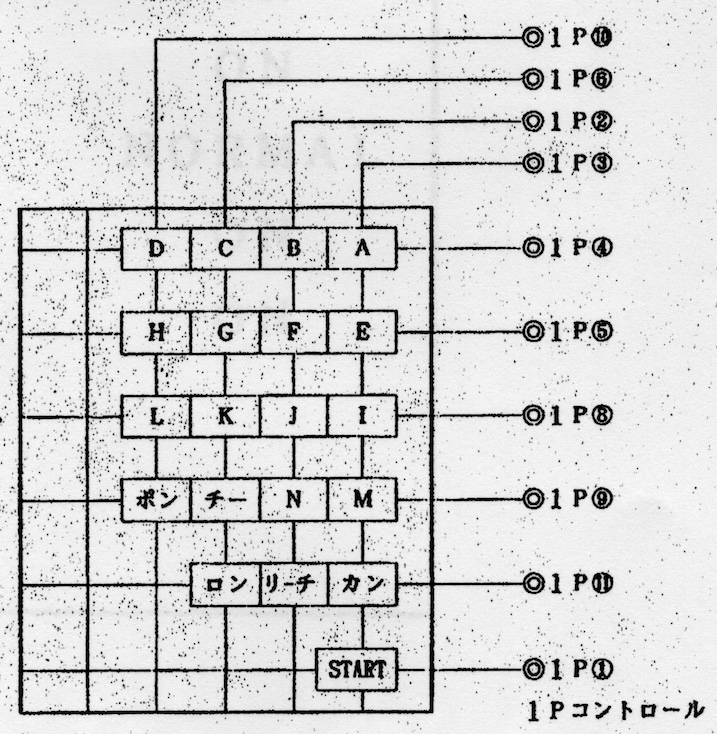
As you can see, with only ten lines, it creates a 6x4 matrix that has 24 possible positions, and because this isn’t a betting-type board (this is from the service manual to the board we’ll get to shortly), there’s plenty of room to spare.
Unfortunately, this does have a downside: for regular games, superguns regularly use the Neo Geo controller, which can have its buttons mapped properly to JAMMA. But the Neo Geo mahjong controller actually uses a different 3x7 matrix layout! So that won’t work without a complex conversion.
It’s probably fine. Neo Geo mahjong controllers seem to go for over $1000 anyway.
The audio difference
So, the pinout is different from regular JAMMA, the controllers are different too, but the video signals are more or less the same. But what about the audio? To refresh, the JAMMA standards put two pins for positive and negative audio; this is an amplified signal designed to be directly attached to an unpowered speaker. Oftentimes this leads to polarity issues, like in Sorcer Striker and Asura Buster, as your supergun might make assumptions about the signal, as it needs to reduce it from amplified to line level.
Well, for mahjong games, even as manufacturers eventually came to an agreement on the overall pinout, they didn’t quite manage to standardize on the speaker handling.
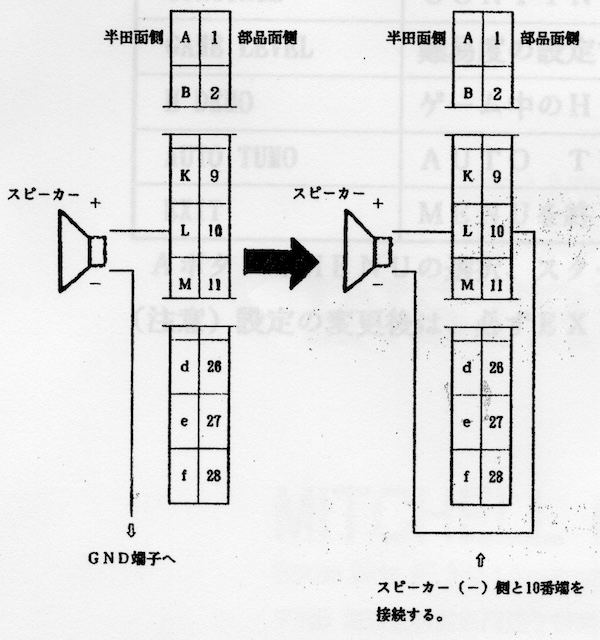
Nichibutsu, who seem to have originated this pinout, just told users to ground one side of the speaker, and only used one pin for the positive amplified audio. (Presumably, the amplifier was wired such to prevent this from being an issue.) However, other manufacturers used the conveniently-unused pin opposite the speaker pin to provide both positive and negative polarity. Unfortunately, Nichibutsu did not connect that opposite pin to ground on their boards, so you need to be able to handle either case with your adapter.
Adapt or… play a different game
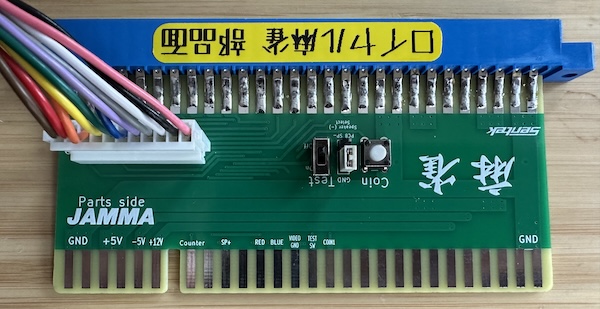
So this is my JAMMA adapter; I ended up just buying one from Yahoo! Auctions that looked good. (My main preference is that I like PCB adapters more than wire harnesses) As you can see, it has a little switch for a test feature, and a jumper for the two different audio pinouts I mentioned. The coin button is just for convenience; if you’re using this on a supergun, you don’t need to leave a controller plugged in just for coin input. Notice that coins are not detected by the matrix above, and have a dedicated pin.
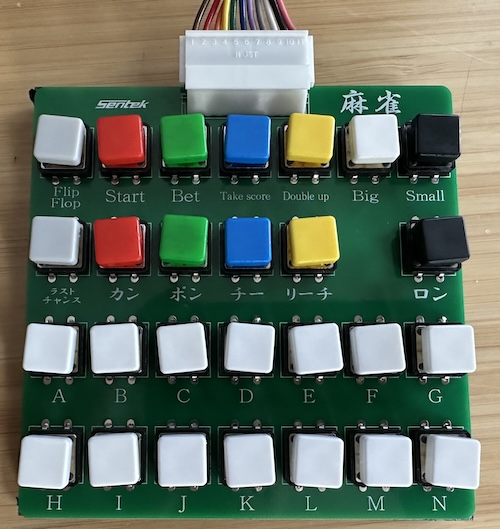
This is the controller that came with the adapter. It works fine, but honestly, I don’t like it. The A-N are split into two rows, and there are a lot of spaces taken up by betting mahjong features I don’t care about; I’d much prefer a layout like my USB controller. I’m guessing this is built this way for ease of manufacture.
That being said, this is literally just a matrix connected to a detachable connector. So while I will use this for now, I do have a few options:
- Create an adapter to use my USB controller. That’s a little complex because the USB controller actually acts as a keyboard (it outputs MAME’s default key assignments for mahjong, which is nice), but it should be possible to intercept the matrix scans properly. Would definitely require a microcontroller.
- Make a new controller. Finally get off my ass and make a proper PCB design rather than just deadbugging everything. It’s literally a matrix and a standard connector! Super easy project, in theory.
- Buy a mahjong panel designed for an arcade cabinet, and adapt it to live outside of the cabinet, maybe with 3D printed parts.
Most likely I’ll try #2 one of these days.
Preparation over!

So, what are we playing with all this? Why, none other than Mitchell’s 1994 Mirage Youjuu Mahjongden, or Mirage: Demon Mahjong Legend.
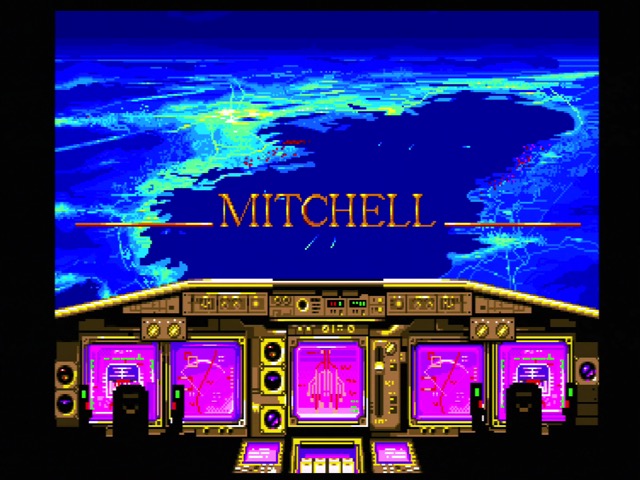
Mitchell Corporation is one of those firms that hasn’t shown up on the blog before, but probably isn’t surprising: another Japanese (Tokyo-based, this time) arcade firm, known maybe mostly for hiring ex-Capcom developers to make Strider spiritual sequel Osman. This game… isn’t Osman. You don’t need a mahjong controller for that one.citation needed
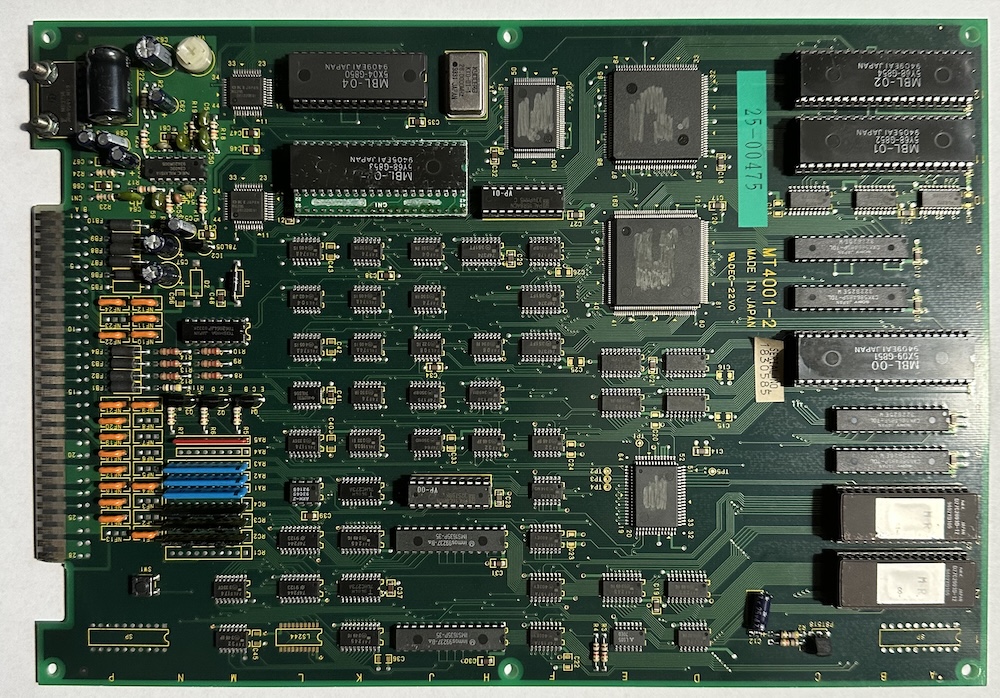
So, unfortunately, someone went and scratched out all the chips of interest. Well, not all the chips of interest; we can see that the sound comes from two OKI M6295 chips, each with four channels of ADPCM audio.
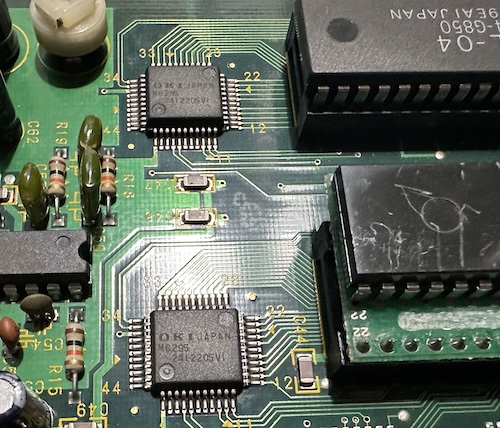
Scratched out chip labels, except for two OKI M6295 chips? This is sounding a lot like Data East’s Gate of Doom!
Okay, I’m being a little silly here, since a lot of games (a lot) used OKI M6295 and a lot of manufacturers scratched out their chips. But Mirage Youjuu Mahjongden does in fact use a chipset from Data East, very similar to the DECO 156 chipset used in Osman. The main difference is, the DECO 156 was apparently a custom encrypted ARM5 CPU. Meanwhile, Mirage uses…
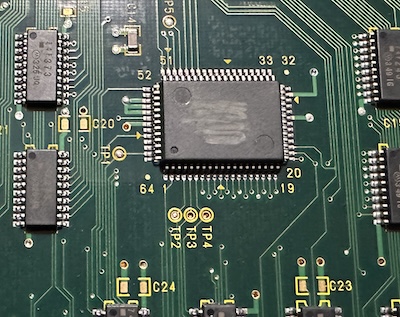
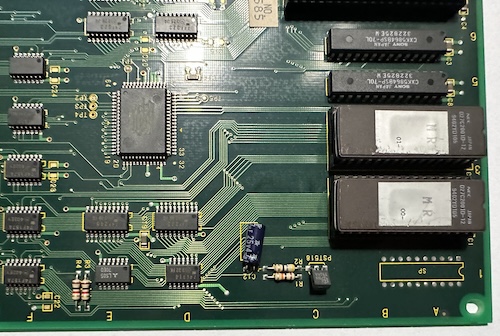
Oh right, they scratched off the labels. But as a 64-pin surface-mount chip near the two “MR-00” and “MR-01” chips that contain the (interleaved) program ROMs, this is very likely our CPU, the 64-pin Motorola 68000. You don’t need that 32-bit ARM chip to play a tile game. And this is pretty common; a lower-end variant of the company’s usual hardware for games that don’t need the high-end features.
The cultural context of 1994 in strip mahjong
So, here’s the thing. I think it’s easy as a westerner to get this idea of the Japanese video game industry as this place where anything goes with regards to sexual content. I mean, a genre like strip mahjong would never exist in the American arcade, right?
But of course, while the bar was definitely different, it still existed, and Japan has its own moral pushes. Not everyone was thrilled with a game like Mahjong Gakuen, where a player could mash the “H” button to molest a naked woman, sitting next to a child-friendly game like Street Fighter, even if they were both by Capcom. (What? No, no, Yuga and Capcom are totally different, I must be confused)
And so in 1992 the Japan Amusement Machine Manufacturers Association, JAMMA, put out guidelines:
- Do not make visual depictions that are similar to sexual activity
- Nobody may take off their underwear
Mitchell seems to gone all in on this idea of the new, family-friendly era of strip mahjong without stripping. They also adopted an anime artstyle, which was replacing the more realistic art of mahjong games at this time. Mirage Youjuu Mahjongden’s women mostly just do provocative poses in the inter-round cutscenes.

That being said, some of these are, shall we say, racier than others? Especially the final scenes. The final scene for this woman is her clothes melting into a demon with a large tongue, and I will say I wouldn’t put this image in the blog without a link barrier, at least. The other women’s final scenes are equally lurid; Maeda Hiroyuki’s blog has screenshots of the rest, if you’re in the mood.
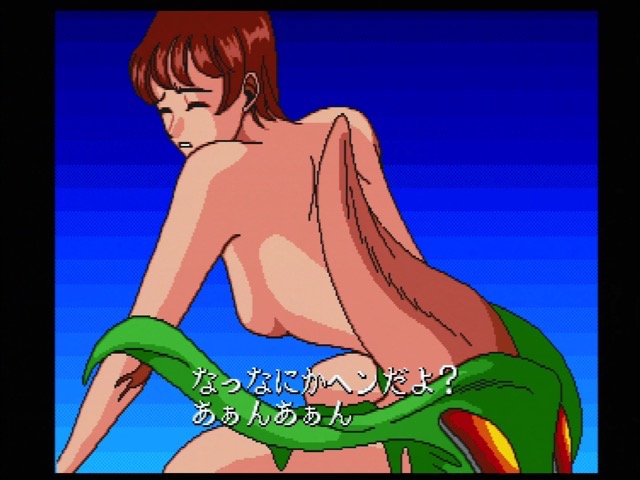
But how well did this all go? Well, Game Catalog Wiki calls it a “バカゲー” (bakage, or “baka game”, “stupid game”), and it was Mitchell’s last mahjong game. So yeah, that says a lot right there. It also seems that later strip mahjong games, even from JAMMA members, at least included nipples. (Which are now censored in their re-releases for modern systems. The circle of life continues…)
A mirage

So, what is Mirage Youjuu Mahjongden? Well, you can watch the dramatic intro if you want details, but it’s a bit vague and flashy.
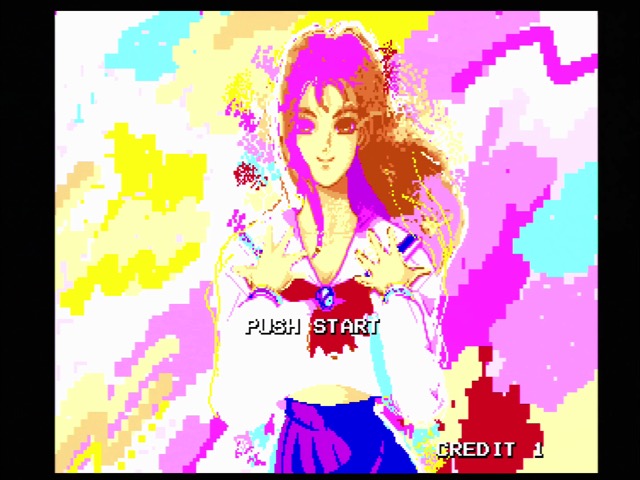
Long story short, demons have possessed all the women of the Tokyo neighborhood of Shinjuku. As a skilled mahjong player, it’s up to you to solve this through strip mahjong. Obviously. And when you get to the choice of girls you can really see that the plot is basically a nothing. It’s also a very barebones take on the genre– there’s basically nothing other than mahjong here.
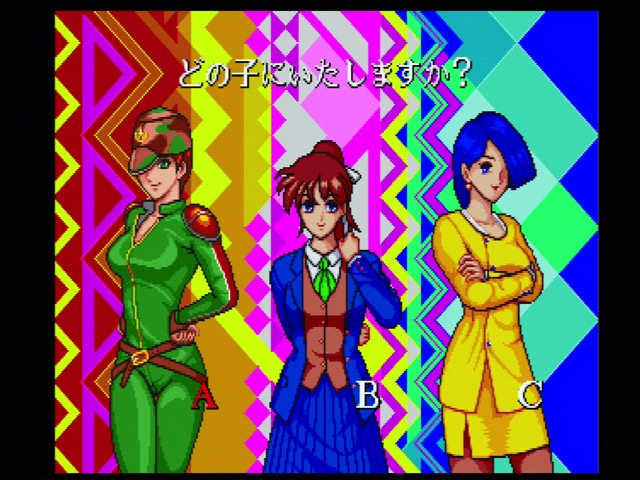
So let’s choose our military girl and get started. She’s apparently landed her futuristic fighter jet on top of a city bus, and crimes against public transit can not be tolerated.

Mahjong, sort-of
So, what is the gameplay of a title like this? Well, mahjong as is typically played is a four-player contest, with each player trading points in wins and losses to end up with the most at the end of the game. Strip-mahjong, like the early 1980’s video games of mahjong for consoles like the Super Cassette Vision, is almost always a two-player affair, as it is here.
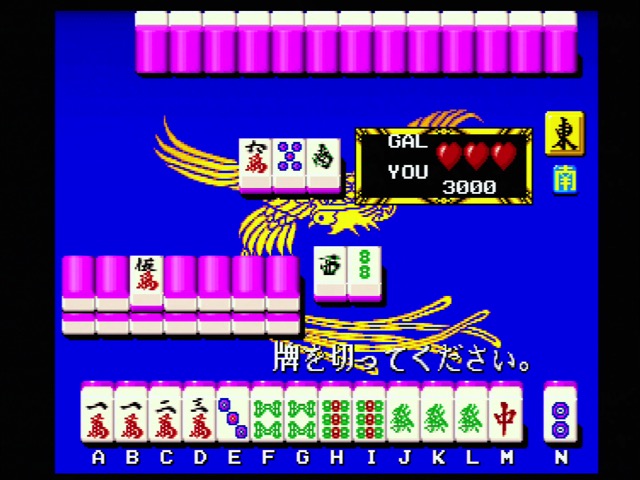
Now, two-player mahjong like this does significantly change the strategy of Japanese mahjong. In theory, riichi mahjong is noted for an emphasis on defensive play, because if you discard someone else’s winning tile, you pay the full penalty, while if they just draw their winning tile, everyone only pays a fraction. But in two-player mahjong, you take the full hit either way, so defense takes a back seat.
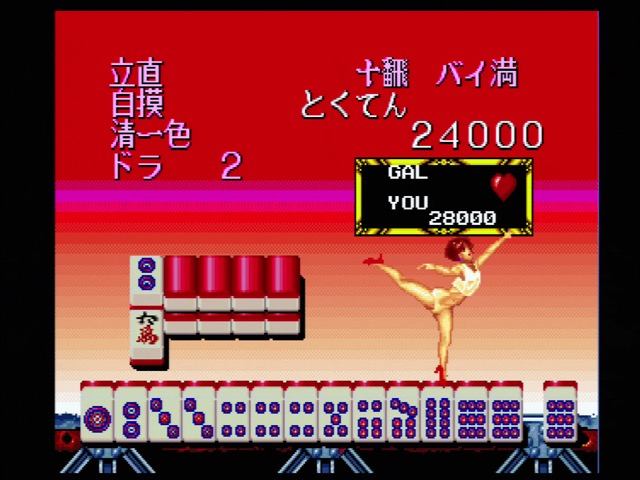
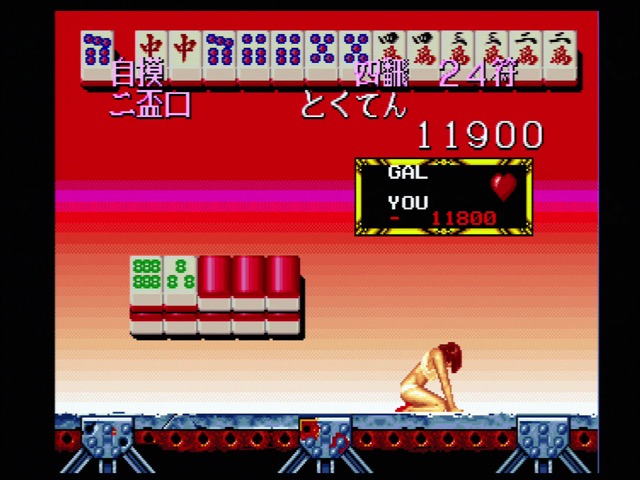
You might also notice that in this game, while the player has points (starting with just 3000), the girl only has hearts. This isn’t the case in all strip mahjong games, but isn’t uncommon either; each heart is lost after a win, and it doesn’t really matter the size of the win. Above I got quite a large win, but it still only removes one heart. You of course live or die by your points, so if the girl wins a big hand, your game will be over.
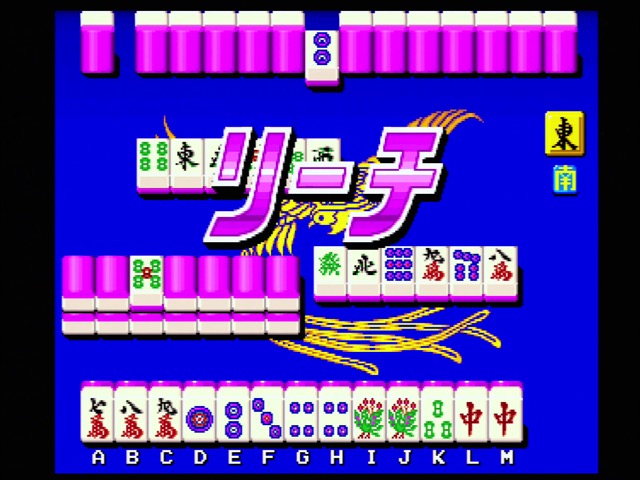
So Mirage Youjuu Mahjongden rewards fast play more than it does high scores or defense. Of course, you get more points for winning, and lose points, but then we get to the other point pretty much every source will tell you about this game: it is hard. The game cheats like hell, giving the girls excellent starting hands. Normal in the genre, but in this case Mitchell went farther than most. I mean, I was playing on easy!
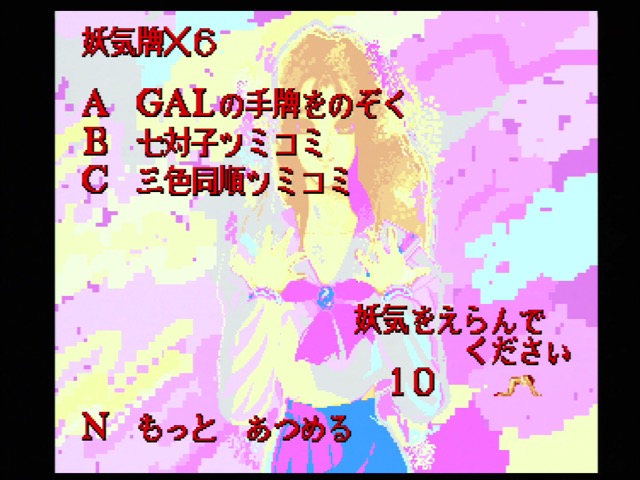
Now, like many strip mahjong games, you can get cheat items. I’m not sure how you’re supposed to earn these; when playing, what I got only showed up the more I lost and inserted more credits, and maybe that’s just how it works? Other games have more ways to earn items, though.
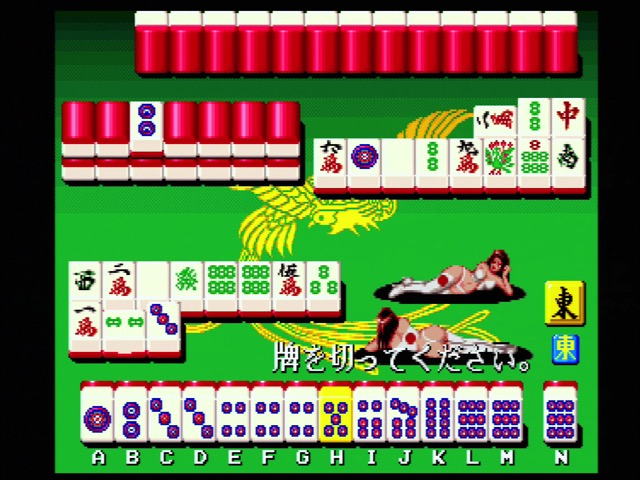
That’s not to say Mirage Youjuu Mahjongden is bad, and there are a lot of nice touches here and there. Who’s that girl in a white leotard? She’s actually your riichi stick, a 1000-point stick that is used to denote the bet one takes when making riichi, but here she’s a character who poses and moves. In the above screenshot, both of us have made that call.
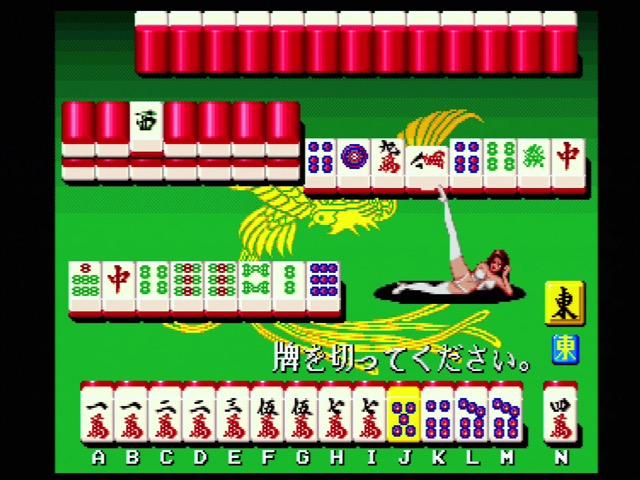
A nice feature is that it autoplays for you in riichi, meaning that the hand can complete quite fast. On the other hand, it seems to land on the opponent making a winning draw more often than not. As I said, the game is unfair even for the standards of this unfair genre. (DonKale4 on YouTube managed to get a yakuman, the best possible hand, in it though, so maybe I’m just bad at video games)
Another genre
So, you might wonder about a verdict. Do I recommend you run out and buy a complex setup to play strip mahjong games at home? Well, uh, no. I don’t. And not because of the genre, but for practical reasons. See, here’s the thing. It’s a mahjong game. Input lag isn’t a concern. While the games are obscure, most are emulated very well in MAME today.
In fact, let me tell you something. Why hasn’t there been any videos in this post? It’s not because I’m saving bandwidth. It’s because this board has a problem. One of the two OKIs, the one that’s associated with the music, doesn’t seem to be working right. Speech samples come in loud and clear, but something in the signal path for the music is wrong, and it’s much quieter than it should be. I checked the capacitors and the board and there’s no obvious issues. But how much debugging should I do on a game like this, a strip mahjong game that players in Japan thought wasn’t very good anyways?
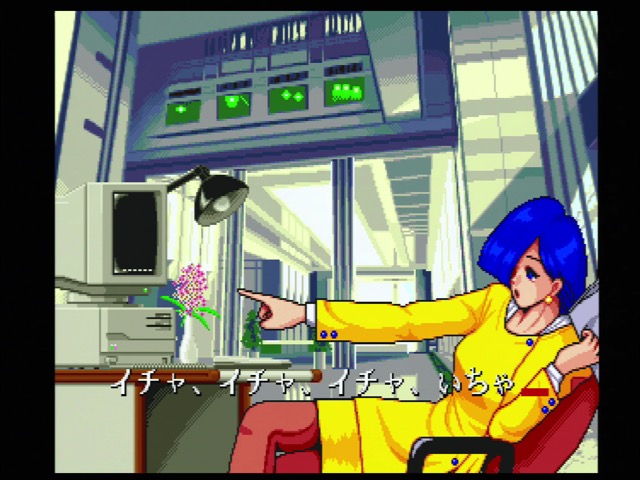
But look, if you’ve been reading this blog for awhile, you probably know I can’t resist things like this. I hope you enjoyed the look at the hardware and the game even if you’re never going to play a mahjong game in your life. And I leave you with this: can you identify the computer the lady in the image above is using? Is it an actual model? Winner gets nothing.