Story Follows Function: Mahjong Daireikai
We like to say that video games are art, and there’s truth in that. But in the capitalist world, video games are also a business. Not everything is the product of an auteur with unlimited funds; sometimes, the funds justify everything. That’s especially true in genres like strip mahjong. At the end of the day, everything is subject to the budget. Sometimes it’s just more obvious. PLUS: The AI apocalypse continues! Ghosts! The Legend of Makai!
Jaleco throws their mega hat in the mega ring
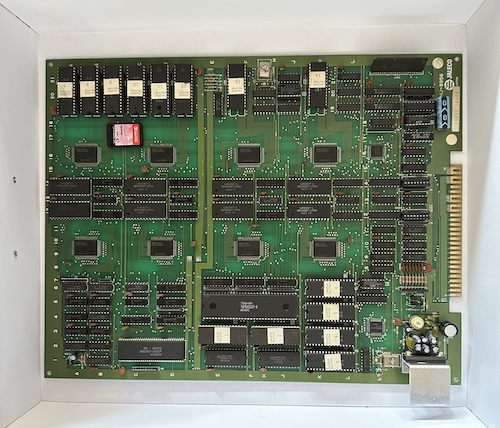
Today we’re looking at Mahjong Daireikai. Daireikai means “Great Spirit World”, but we’ll get to that later. This is a Jaleco game from 1989, developed by NMK for a variant of the Jaleco Mega System 1 platform.
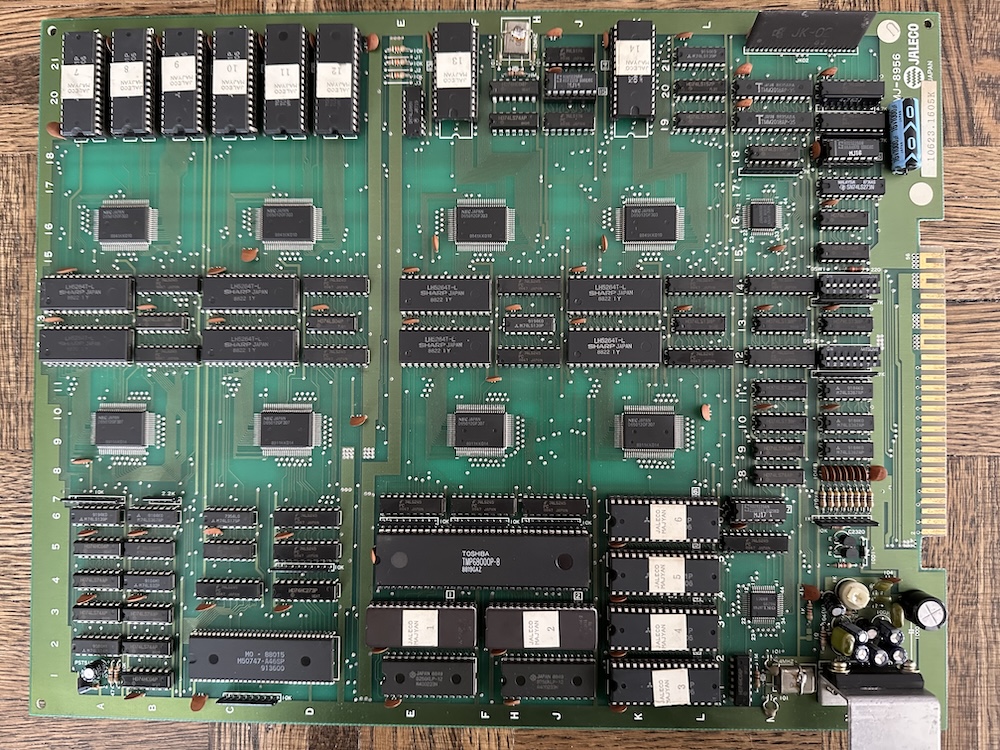
And if that all sounds familiar, it should– Legend of Makai from 1988 was also a Jaleco-published game developed by NMK for the Mega System 1 hardware. In that case, the “Z” variant; Daireikai is the mahjong-specific variant. The mahjong variant is slightly smaller, and doesn’t have as much discrete logic. Why?
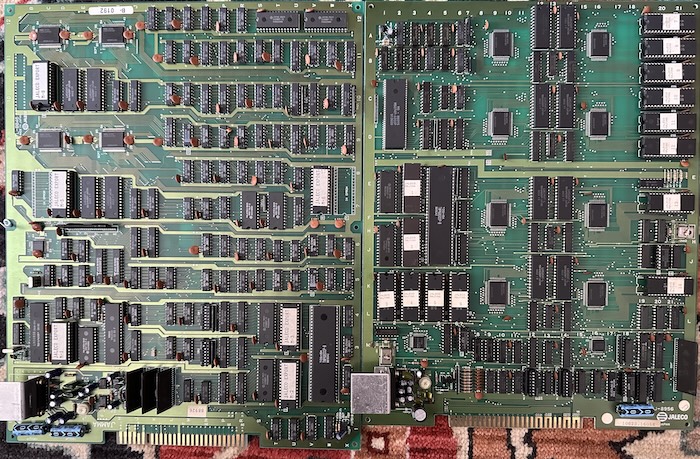
I think this is an excellent example of how the “same” chipset can produce different games with very different functionality. Because while Mahjong Daireikai and Legend of Makai both use chips from the parts bin Jaleco labeled “Mega System 1”, they don’t have the same capabilities.
| Legend of Makai | Mahjong Daireikai | |
|---|---|---|
| CPU | 6MHz Motorola 68000 | 6MHz Motorola 68000 |
| Tilemaps | 2 | 4 |
| Sprites | 127 | 0 |
| Audio CPU | 3MHz Zilog Z80 | |
| Audio Synth | Yamaha YM2203 | OKI M6295 |
Think about it. This is a strip mahjong game, based around full-screen images, and tiles that go in fixed places on the field. You don’t need sprites for that, and on Jaleco’s hardware, they were separate chips. So they can go away. Tilemaps are more useful. 4 is actually quite a lot of tilemaps; outside of mahjong titles, Mega System 1 titles were generally limited to 3 at most.
Security
Like a lot of arcade manufacturers, Jaleco was concerned about having their hardware cloned. And they used a common strategy to get around that: a microcontroller, in this case labeled M50747. The microcontroller is configured so that you can’t get it to dump its internal program, so it can’t be cloned without reverse-engineering its functionality. You then make that functionality crucial to the game’s operation.
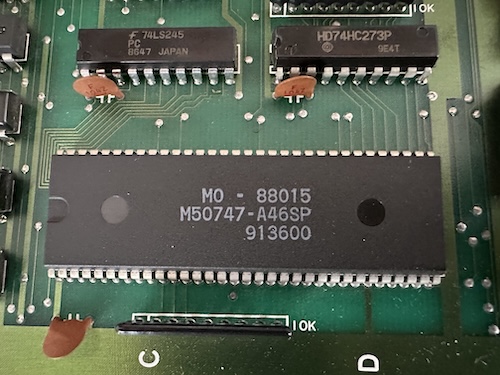
This microcontroller is still not dumped, actually. Nobody with the equipment to decap cares enough to do so; its functionality has instead been reverse-engineered to make this game emulatable– one key functionality the microcontroller handles is input. Interestingly, the Legend of Makai does not have any equivalent to this, so my guess is the clones of Mega System 1 only showed up after that game’s release.
The sound of tiles
The OKI M6295 should sound pretty familiar to this blog at this point. 1990’s Gate of Doom, 1993’s Sorcer Striker, and 1994’s Mirage Youjuu Mahjongden. It’s a four-channel ADPCM chip that’s been used many things.
But where Mahjong Daireikai differs from those titles is that it only has one. Well, Sorcer Striker only has one, but it’s paired with an FM synthesizer; this only has one, and that one is the only thing hooked up to the speaker output.
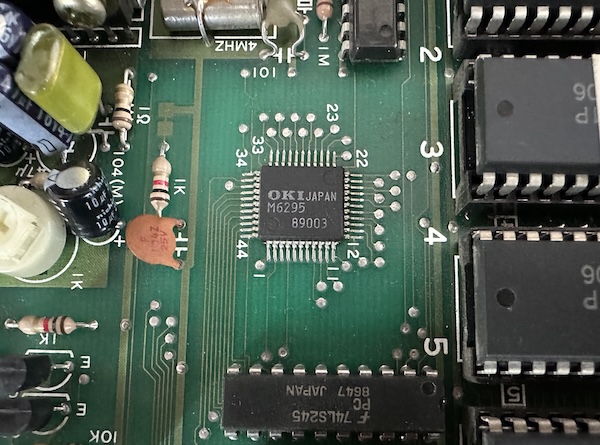
It gets worse. The OKI M6295 is a sample playback chip, and so naturally it depends on a sample ROM. The sample ROM on Mahjong Daireikai is tiny, limited to 256kiB.
We can decode the audio pretty simply; here is a useful command line tool. Setting it to 20000Hz reveals the following audio, which is all the audio that Mahjong Daireikai will ever be able to make. Be warned, it’s a bit loud.
And you might notice something interesting. There’s no male voice making mahjong calls. Why? And can plot work around this?
The Great Spirit World of… what?
WARNING: THIS SECTION CONTAINS SOME LIGHT NUDITY
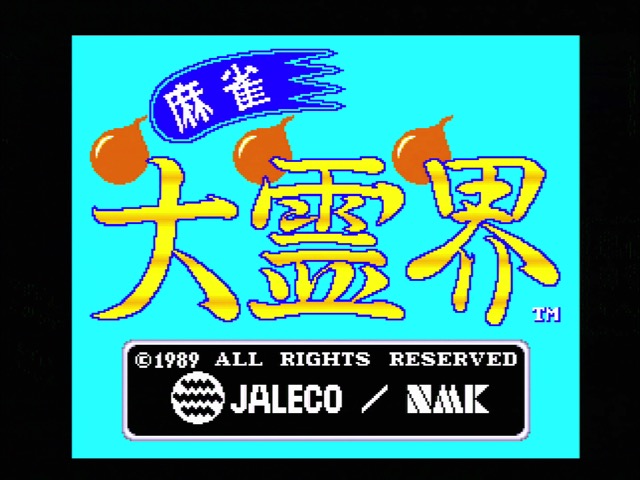
So, if you go around searching the Japanese internet, you might find this article, “NMK’s Eerie and Bizarre World of the Arcade Game Mahjong Daireikai”. It tells you about the eerie ghosts and yōkai Mahjong Daireikai offers and its strange atmosphere as the player navigates the spirit world. It fails to describe any stripping at all!
This is also completely wrong. Mahjong Daireikai is an extremely obscure game, and while what that article describes is what a game with that title might be like, it’s also not at all connected to the reality thereof. Combine that with the publish date of 1/7/2026, and I can say with a high probability that this is almost certainly the output of a large language model. Or as you might say in common vernacular, “slop”. Did you think only the English internet was plagued by this?
The actual plot of Mahjong Daireikai is much, much sillier. And, um, also less safe for work.
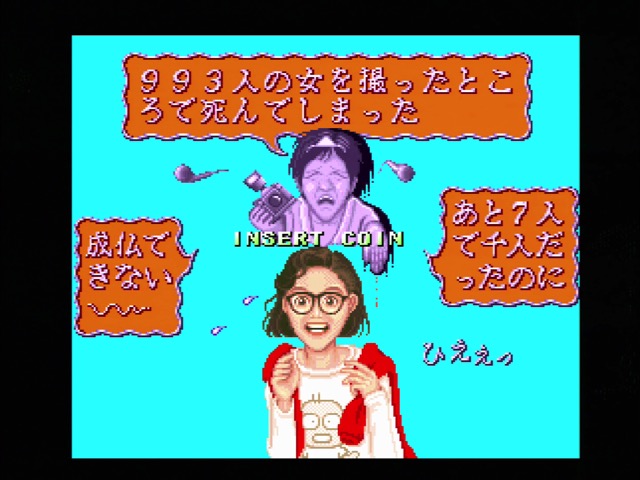
Our intrepid protagonist is indeed a woman, but she is haunted by a spirit. A spirit who has taken 993 naked pictures of women, only to die before completing the final seven. He can not carry on to the afterlife until this is complete! Thankfully, his camera also died alongside him, so he has a spooky ghost camera.
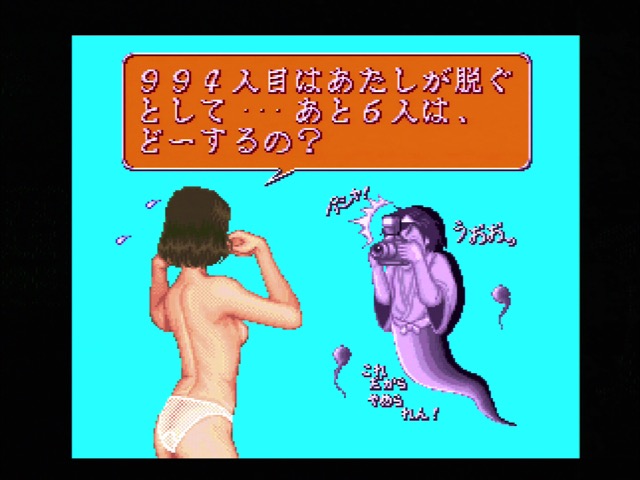
Our intrepid protagonist, who looks like she could maybe stand to eat a bit more (a recurring theme with the women of this game; perhaps the ghost is a famine-induced hallucination and this game is much darker than I initially thought), is moved by the spirit’s tragedy and quickly strips off her clothes to become naked woman #994. However, she notes that she doesn’t know what to do to help him get the the final six.
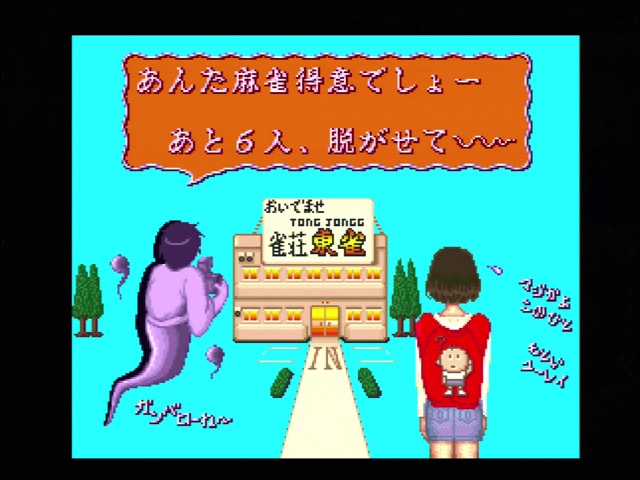
Thankfully, the ghost points out that our protagonist is good at mahjong! So all she needs to do is beat six other women at what I guess is some sort of strip mahjong tournament going on.
“But Nicole, if there’s a women’s strip mahjong tournament already, why do we need the whole story with the ghost? Isn’t that enough alone to solve the problem of only having women’s voices doing mahjong calls!” Don’t ask me, ask Jaleco. But more seriously, I don’t think the lack of memory is the only reason for the story. The story is also funny and gets attention. It pretty much is the entire attract mode, after all.
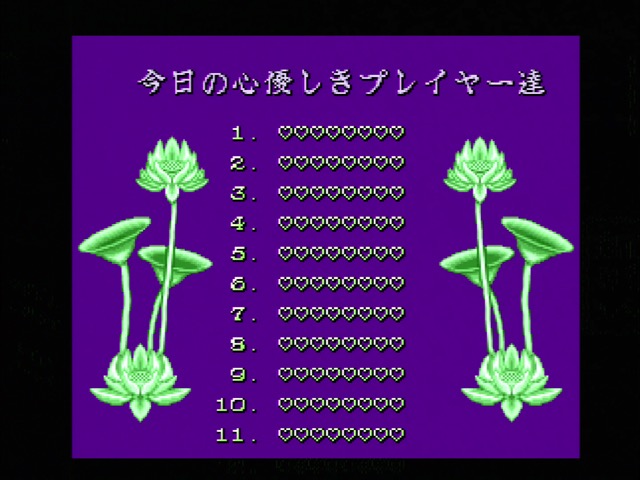
After that you go right to the high score table, then the title, and then it loops again. A high score table in a strip mahjong game is a little weird to me, but hey, if you get a yakuman or something it’s good to have something to be proud of. After a long session, take all your friends and family down to the arcade to show off your skill at strip mahjong.
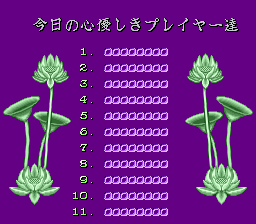
Interestingly, all the zeros are hearts here. This means that this particular Mahjong Daireikai ROM set doesn’t match that in MAME, where the zeros are, well, zeroes.
Dare to compare
The ROMs are labeled “JALECO MAJYAN” on my copy; “majyan” is just yet another way to romanize マージャン, the Japanese word for “mahjong”. (“Mahjong” is borrowed into English directly from Chinese) The program ROMs are Mitsubishi M5M26C101K-2 EEPROMs, which can store 128kiB. Interestingly, they are labeled underneath their sockets, too.
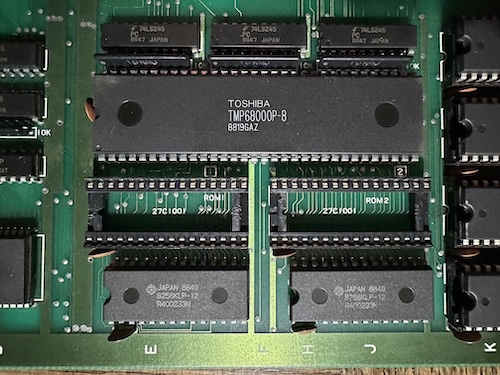
Note that these are two 8-bit ROMs that are used in parallel, as the Motorola 68000 quite famously has a 16-bit bus; this is extremely common. One ROM provides the lower 8 bits, the other the higher 8 bits. As a result, the total program space is 256kiB. MAME romsets will generally keep these in separate files because it makes them more convenient for comparing to ROMs directly taken from the arcade PCBs.
A quick check, however, showed that the program ROMs are identical to those in MAME. To determine this, you don’t actually need a copy of the MAME dump; the MAME source contains SHA1 hashes of the ROMs in question. They match exactly, which means that the “0” vs “♥️” is just a matter of the graphics ROMs. (But see below)
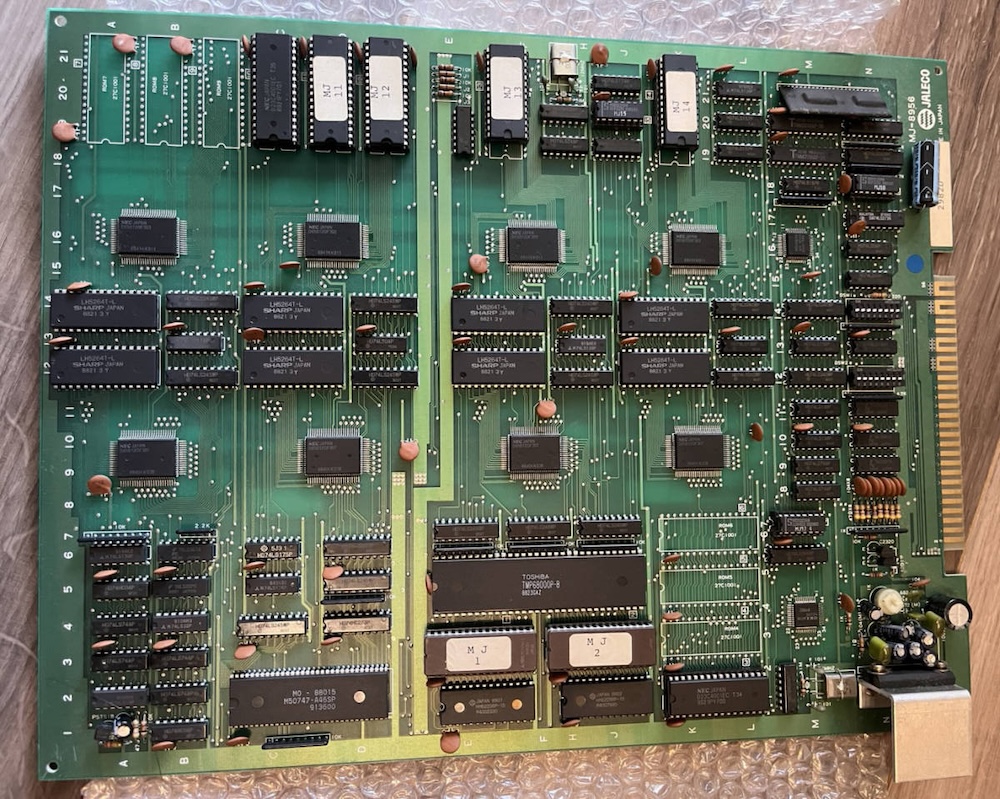
Here’s an interesting image of another copy of Mahjong Daireikai from Yahoo! Auctions, which in this case was being sold as junk. Notice the “MJ” labels and that there are no ROMs in positions 7, 8, and 9. This matches the filenames in the MAME dump, and it’s missing those three ROMs as well. However, I notice something– the empty ROM sockets are labeled for 27C1001s, 128kiB EEPROMs. ROM “mj10.bin” just so happens to be 512kiB; if that was instead spread across four 27C1001s (7, 8, 9, and a smaller 10), it’d make sense. Having the option to wire boards for different configurations of ROMs depending on what’s available is pretty typical.
When I have ROMs out anyway, I like to look for any interesting strings. In ROM 1, I see at address 0x1fdb2 the string KIYOMOTO. This might be a reference to developer Kiyomoto Testurou, but while he did work on NMK and Jaleco titles in the relevant period, I’m not sure it’s known whether he worked on this title. It’s followed by seven strings of AKIRAAAA. The developer actually being named Kiyomoto Akira? A reference to a popular movie that just came out?
0001fdb0: 0300 4b49 594f 4d4f 544f 0000 0000 0000  ..KIYOMOTO......
0001fdc0: 0200 414b 4952 4141 4141 0000 0000 0000  ..AKIRAAAA......
0001fdd0: 0100 414b 4952 4141 4141 0000 0000 0000  ..AKIRAAAA......
0001fde0: 0100 414b 4952 4141 4141 0000 0000 0000  ..AKIRAAAA......
0001fdf0: 0000 414b 4952 4141 4141 0000 0000 0000  ..AKIRAAAA......
0001fe00: 0000 414b 4952 4141 4141 0000 0000 0000  ..AKIRAAAA......
0001fe10: 0000 414b 4952 4141 4141 0000 0000 0000  ..AKIRAAAA......
0001fe20: 0000 414b 4952 4141 4141 0000 0000 0000  ..AKIRAAAA......
I’m not sure what purpose these have. Are these a developer message, a remnant of an earlier version of the high score table, or something that would make sense in the credits? (I haven’t actually beaten this game) I’m not sure. Note that these are just the low bytes, though the high bytes are mostly just 0x00 in this region.
UPDATE 2/8: Augite on my Discord server noted that the reason for “0” vs “♥️” may actually be the emulated MCU protection system behaving differently from the real one; in that case, there may be nothing different about my board at all.
Gameplay
Mahjong Daireikai is a strip mahjong game. Despite the amusing plotline, the game itself plays in an extremely standard fashion. You can buy cheat items, which are paid for in gold coins. You can get those gold coins after each match, which are scored according to a table in the flyer; essentially, the bigger your hand is, the more coins you get. The items, of course, help you get bigger hands, so this should be a virtuous cycle.

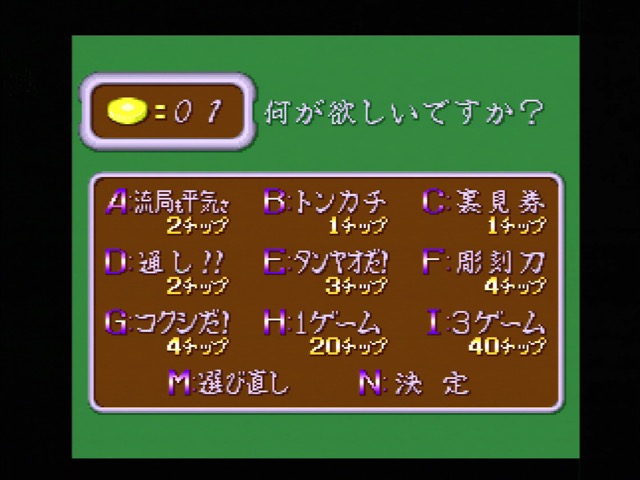
The gameplay loop is exceedingly simple; you pick one of the three girls you have access to at a time, then play a round of strip mahjong with them. Interestingly, you can switch between the girls between rounds, in case you want to make sure they’re all evenly undressed; they need to be naked for the ghost to move on to the beyond, however.
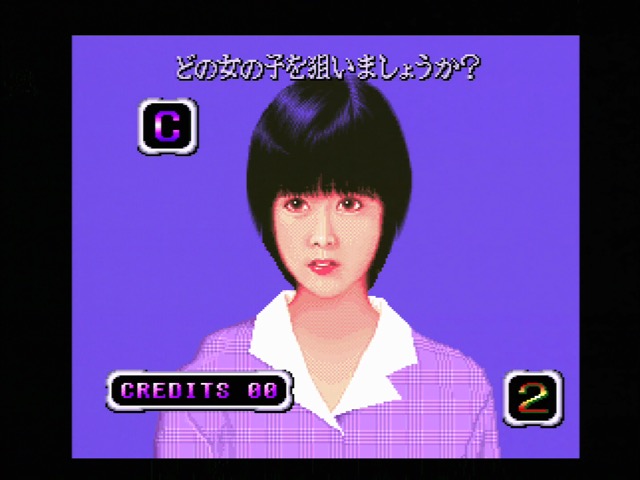
The flyer also claims that each girl has a preferred hand they try to get. Girl “C” here likes to try for “chiitoitsu”, the seven-pair hand; assuming there’s actual AI preference here this is a pretty sophisticated logic. She notes that she will likely end up with a “tanki” wait as a result; this is a wait where you are trying to form a pair, which gives fewer clues at the cost of having fewer tiles that can solve it.

The other thing worth noting is that the limited sound features also means there is absolutely no music in the game. And that’s a real shame; maybe it mattered less in a noisy environment of the shady back row of a busy arcade, where the crisp sound effects of the tiles are all you need, but playing it in my apartment I’d rather have some music.
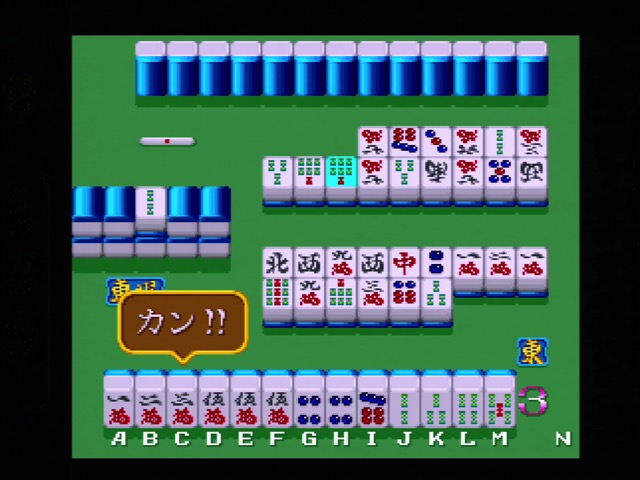
The gameplay is as bog-standard two-player mahjong as it gets, and like Mirage Youjuu Mahjongden, is extremely difficult even on the easiest difficulty setting. I did notice that the AI is smart enough to do calls for discarded tiles, which is not something I always see. (On the other hand, such a call disqualifies a hand from being chiitoitsu)
Unlike many games, you’re not allowed to stop playing this one. Instead, the ghost hypnotizes you to put another coin in and keep playing, which is highly unethical.
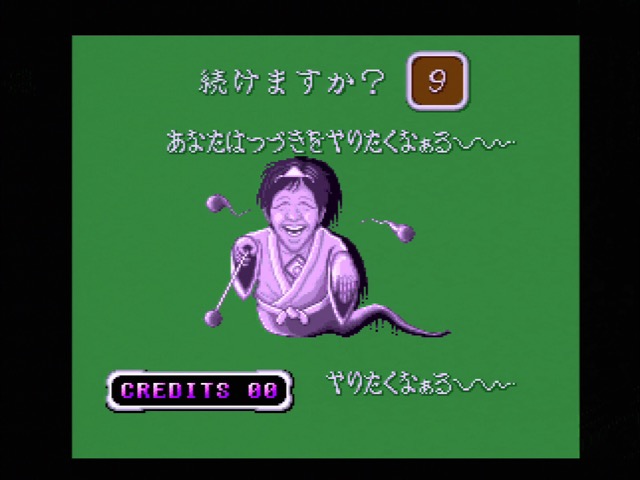
Mahjong Daireikai is, as far as I can tell, a product manufactured for market reasons, to make sure Jaleco had something in this market, and made at a price wherein they didn’t need to pay for music composers or an extra synthesizer. At least the plot shows that the developers found some ways to have fun with it. (And yes, there are nipples. Scandalous!)
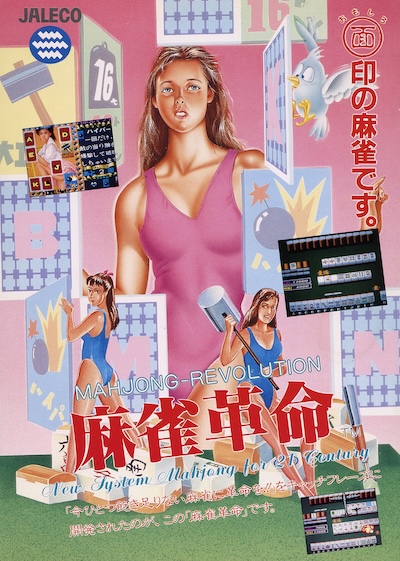
Jaleco’s next mahjong series, Mahjong Revolution (or “Mahjong Kakumei” if you refuse to translate words even the flyer translates), would use very similar hardware to Mahjong Daireikai, and also used female voices for the player’s calls, but didn’t really have a story. Its main selling point was a tile-matching game that replaced the item system. This was followed in turn by the Idol Janshi Suchie-Pai series, which is available on Nintendo Switch. With censorship, naturally.